A Heart to Heart for the Divyang - Global Education Summit 2025
Are Education and Vidya, synonymous? Education or Shiksha, imparted in schools provides certification, but may or may not lead to learning. Vidya refers to knowledge and wisdom. It nurtures the intellect and the soul. Imparting and imbibing Vidya, ensures learning.
A mother knows when her child is hungry, sleepy, tired … because she is connected. A father, while communicating with his child, either squats to the child’s level or lifts the child up in his arms. Because for effective communication, there has to be eye-to-eye and heart-to-heart contact. Children express themselves best, to their parents. But after infancy, inevitably they need to move on to the schools.
Schools therefore, need to be cognisant of different kinds of learners and different methodologies of teaching. Different children, learn in different ways and at different paces. Each one of us is born different in looks, colour, height, blood group etc. So too, each one of us is differently wired, in the brain. This is called Neurodiversity, and it is nature’s norm.
Only a handful of people understand that specially-abled children or Divyang, are not able to learn and understand by conventional methods of teaching. The norm has been to send them to special schools. But this isolates them, from mainstream life. They miss out on a lot and often end up as social outcasts. The New Education Policy - NEP 2020, recognises that all schools need to be ‘inclusive’. This means that school premises, curriculum, teachers and peer mindsets should be adapted and open towards including all kinds of learners.
I work as a volunteer with the Sri Sathya Sai Vidya Vahini (SSSVV). Sri Sathya Sai Vidya Vahini (SSSVV) is a volunteer driven, digital initiative of the Sri Sathya Sai Central Trust focusing on providing Integral Education to rural schools.
The Ministry of Education, invited Sri Sathya Sai Vidya Vahini to create content, fit for inclusive classrooms. We started creating such content in January, 2022. The content created by the volunteers of SSSVV is uploaded to the Prime Minister’s DIKSHA Portal.
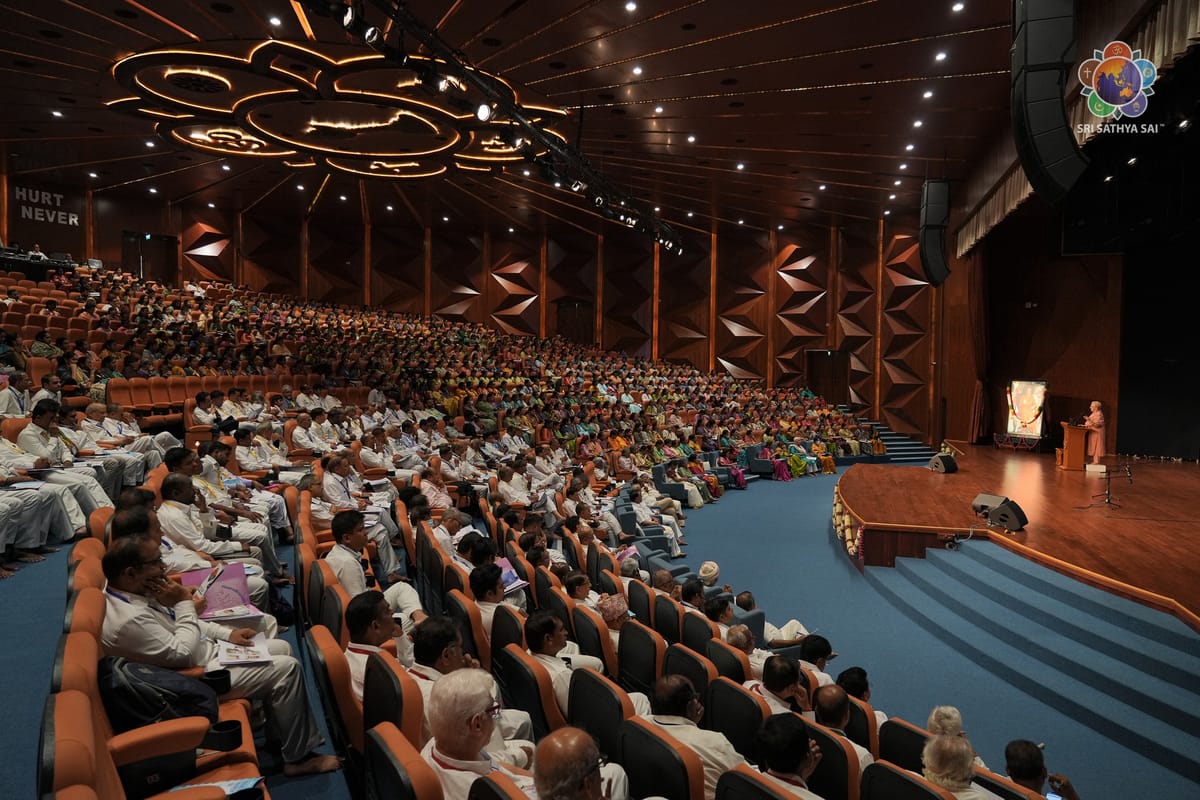
The Global Education Summit -2025 was held in Prasanthi Nilayam, Puttaparthi, Andhra Pradesh, under the spiritual aegis of Bhagawan Sri Sathya Sai Baba, from June 25-27, 2025, at the Sai Hira Global Convention Centre. This summit was held to brainstorm on, ‘Neurodiversity to Neuroplasticity’. Neurodiversity, recognises neurological differences as natural variations of the human brain; being not deficits. Neuroplasticity, enunciates that the brain is capable of reorganizing itself and forming added neural connections all through life. A galaxy of experts from the field of education both traditional and allied, attended the conclave.
Why should super-intelligent children be labelled as nerds, or the slow ones as unintelligent, or difficult? All children/learners should be accepted as they are, and taught as they need to be taught. If they can’t learn how you teach; just teach them how they will learn!
In conditions like autism, ADHD, ASD etc. the neurons in the brain become lethargic and new dendrites do not grow. New neural connections are not formed. But if the brain is exposed to challenges and stimulating experiences, the neurons in the brain, begin to sprout new dendrites. Music and dance are ace methods for helping children who are specially-abled, to learn as well as express themselves.
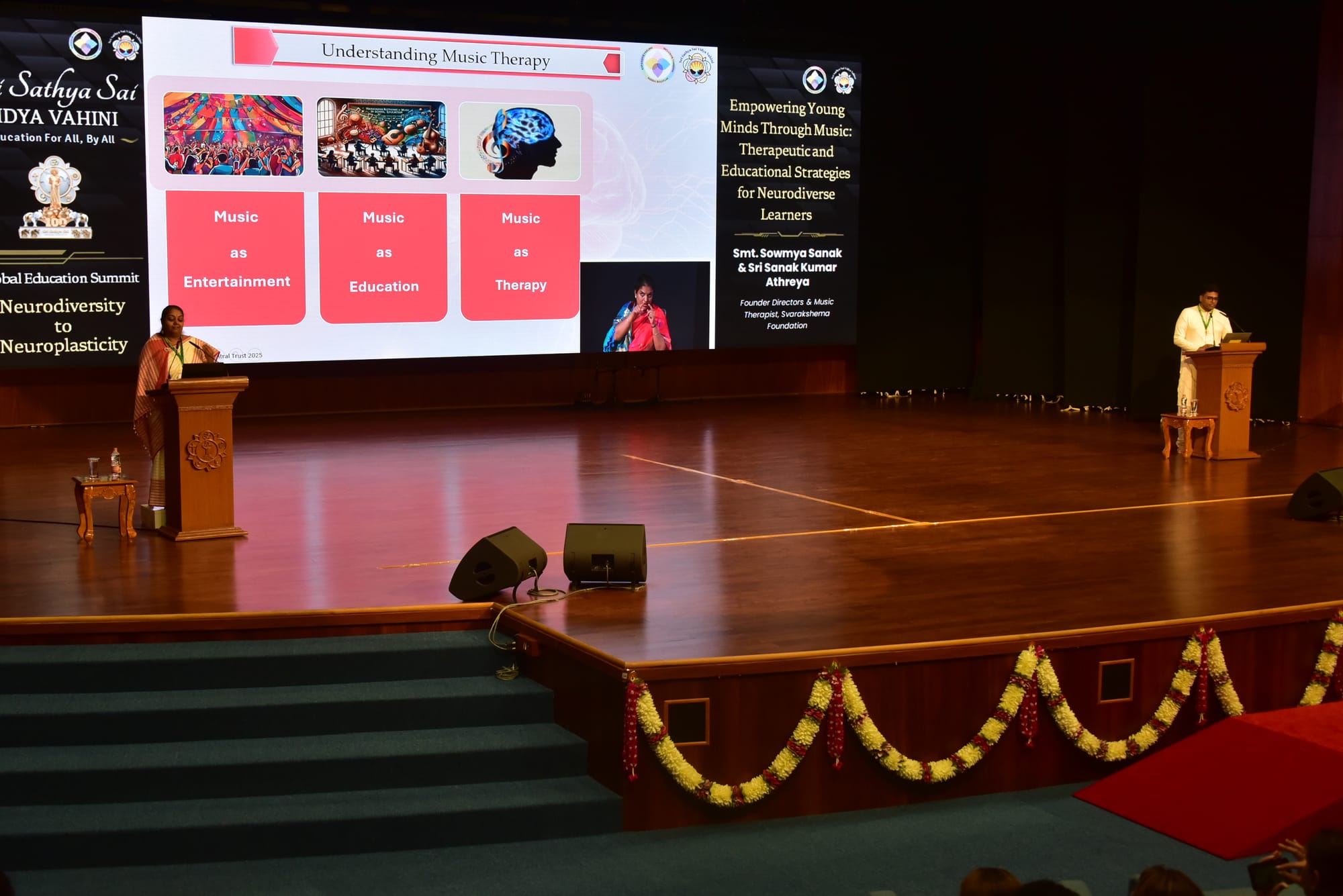
One expert, presented brain stimulating exercises titled, ‘Flex your Cortex’. To my delight, ancient Indian wisdom and games were used. I had seen people, stand in front of the temple deity, cross-hold their ears and do mini-squats. I always thought it was a way of asking for forgiveness. In our parents’ generation, this was also a punishment given to school children, for being inattentive or even hyper. They called it Muruga Bann. Well! As per the expert, this simple exercise opens up the cerebral cortex! Our ancient wisdom was so scientific!
I learnt that the brain is 25% developed at birth, 70% by the first birthday and 85% by the third birthday of the child. By age five, the brain is 92% developed. For the brain to develop, the child needs to be exposed to learning experiences with people and things, nature, situations, circumstances, etc.
Traditional Indian wisdom encourages mothers to talk to their unborn foetus. Mothers are encouraged to talk to and caress their babies especially on their head, while breast-feeding them. This stimulates the brain. Love and care are the greatest emotions that build the emotional well-being of a child. A child who is cared for at home often has better neural connections.
Playgrounds created at home do not serve the purpose that community playgrounds do. It is in a playground that the child learns to interact with children from other communities, ages, gender, colour, strata of society, etc. The interactions with different kinds of children, stimulates the neurons of the brain to think, process and understand. This not only to promotes physical growth by running, playing on swings, slides, merry-go-rounds, etc., it stimulates the emotional and mental growth of a child.
This makes me think of the ancient wisdom to play and do yoga in the outdoors. Games like langri taang, kabaddi, hopscotch, gilli-danda, pallanguzhi … were about being in the community and making social interactions. Children were made to participate in cultural events, prayers, bhajans, dances, Ram-leelas, Janmasthmi celebrations … the modern child thinks these are just for the oldies. The minds of the children need to be fuelled always. Prayer and meditation can teach a child to focus on the inner self. If our thoughts are focussed, our mental-health integrates. If our thoughts are flying in all directions, our mental-health dis-integrates.
Our very own Indian Panchatantra stories are fables, of animals having good and bad habits. They were written at the behest of King Amaraski, for the benefit of his three sons, who were not interested in studying and would not respond to regular methodologies of teaching. The king asked a scholar Vishnu Sharma, to devise a method to teach morals, goodness and governing skills to his sons. The author, created a collection of five volumes known as Panchatantra. The stories therein are suffused with values and teachings on multifarious topics. This would be the first time content was created for inclusive education!
Parents are the first teachers of the child. Teachers often refer to their students as ‘our children’. So, teachers are the second parents. If both sets of teachers and parents work together, then the sky is the limit for the children! Parents and teachers need to upskill themselves to learn to teach, each learner the way he/she, wants/needs to learn. Our children are our future. Let’s give them our best. When Einstein and Newton, could excel, despite being autistic, surely anyone can!
The Global Education Summit 2025, brought together many intelligent minds. It was overwhelming to see the good work many empathic souls are doing in this field. New ideas and practices were presented. But the ancient truths about showering children with tender loving care, were at the heart of everything. As Sri Sathya Sai Baba said, “Love all, Serve all. Help Ever, Hurt Never!” This is the way forward for parents, teachers and everyone else!
This piece has been published in The Daily guardian on 5th July, 2025. It can be viewed here https://epaper.thedailyguardian.com/view/2671/the-daily-guardian/8
Do subscribe to my blog, to stay connected :)
Comments ()