
Divine Vibes at Anjanadri Parvat
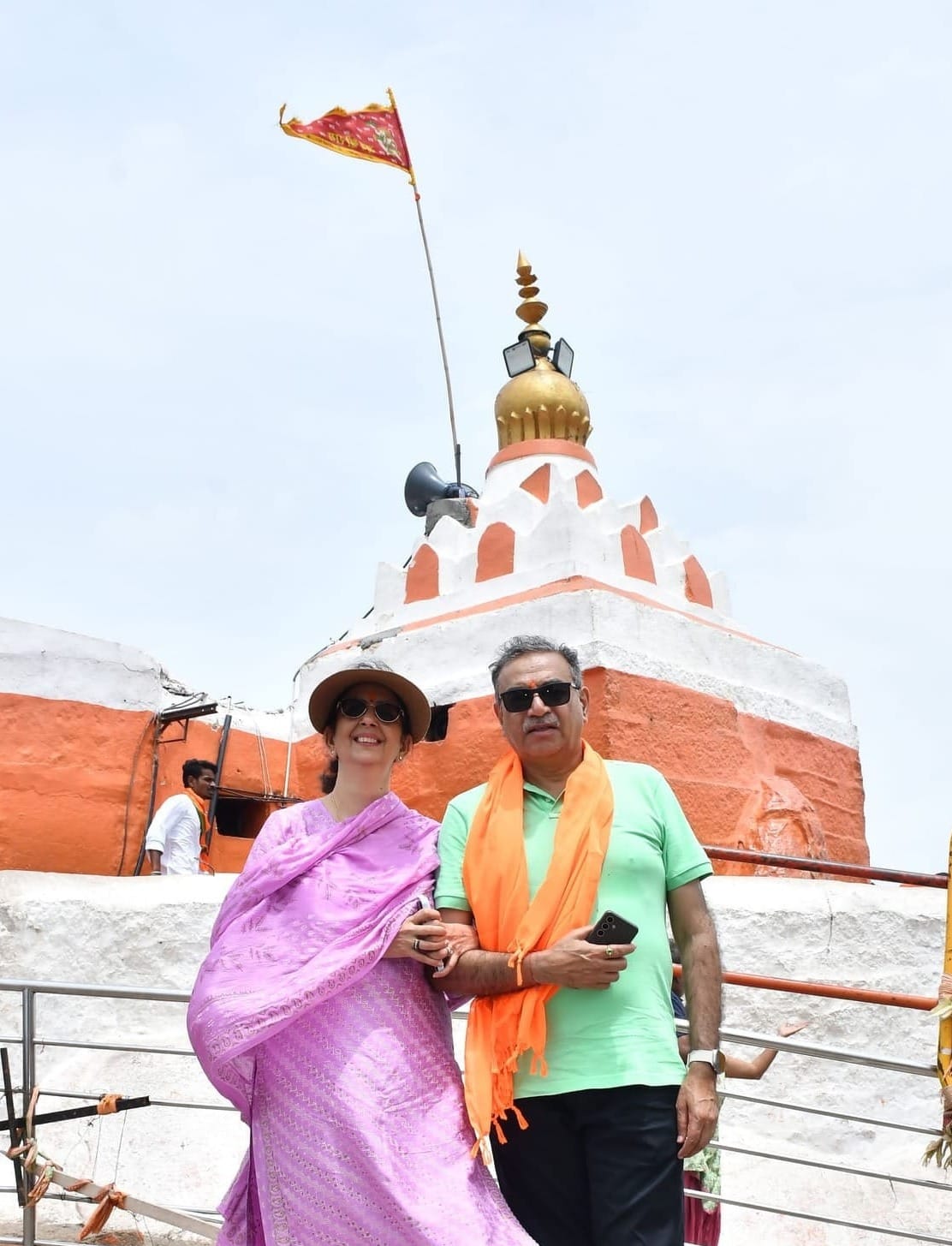
Bharat is home to a rich cultural heritage, devotion, pulsating divinty and much more. My husband and I recently visited the UNESCO World Heritage Site, of the Hampi ruins in Karnataka. Hampi is mentioned in the Ramayana, as Kishkindha, the kingdom of Bali and Sugreeva. In the 15th-16th century, this was called the Vijayanagar empire. King Krishna Devaraya’s empire spanned from the Krishna River in the North to the Indian Ocean in the South.
My husband dearly wanted to visit the birthplace of Lord Hanumanji at the Anjanadri Parvat in Hanuman Halli, Karnataka. Amazingly the opportunity came, just before Guru Purnima. We reached Hampi at 11AM and went straight to the Anjanadri Parvat base. It was a divine brainwave that had prodded us to get a pair of kneecaps each. At the risk of being branded overcautious, both of us wore kneecaps as we embarked on our divine adventure. Our guide said that there were 575 steps uphill; but the steps at the rear, were a 100 less. He said that the views from the rear, would be less picturesque compared to the front, but the stairs would be less steep. Considering that both of us have completed 60 revolutions around the Sun, I was hugely sceptical, if we could do it. At the advice of a friend I tied a cotton cloth around the hips, called Kamarbandh in Ayurveda. Slowly and steadily, we were able to make it to the temple, at the top of the hill! Divinity was pulsating and palpable all around; and we were completely immersed in it!
When we reached the Garbha-Griha, the curtain was drawn. The Lord was partaking of the lunch Bhog. As the curtain opened, we had the most beautiful darshan of Hanuman ji.
Hanumanji here, looks towards the South direction. The idol is more like a mural on the wall. Being in the side-pose, only one eye is visible.
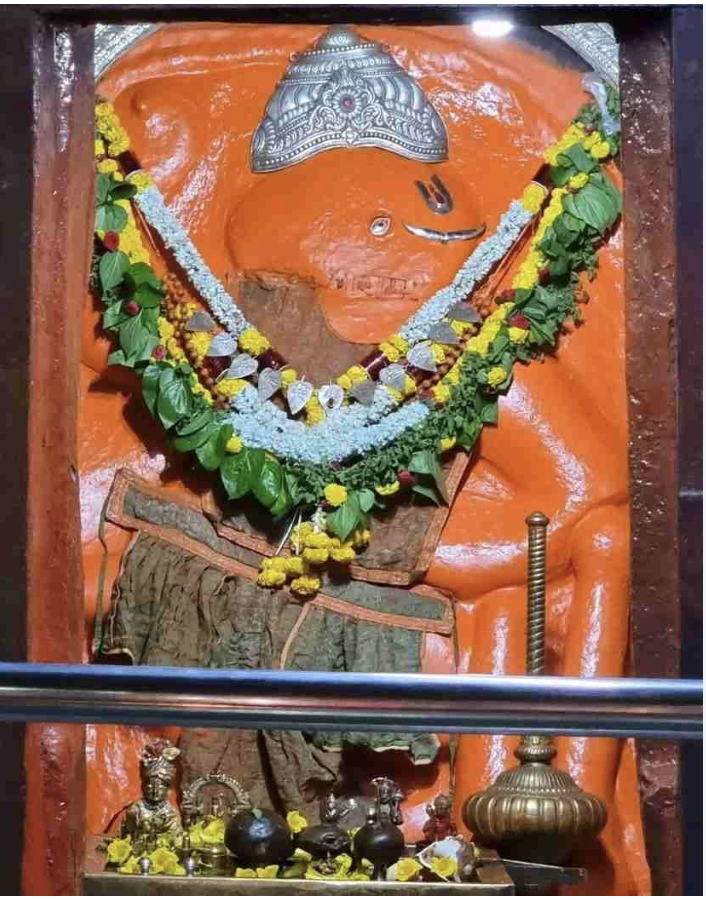
The bhog thali was handed to the panditji in waiting and we quietly prayed to partake a few morsels of it. The will of the Lord is truly unfathomable. The head Panditji said to my husband, “Bhog prasad grahan kar ke jaana.” We were overwhelmed and mesmerised as he gave both of us, a flower garland each, from the Hanumanji idol.
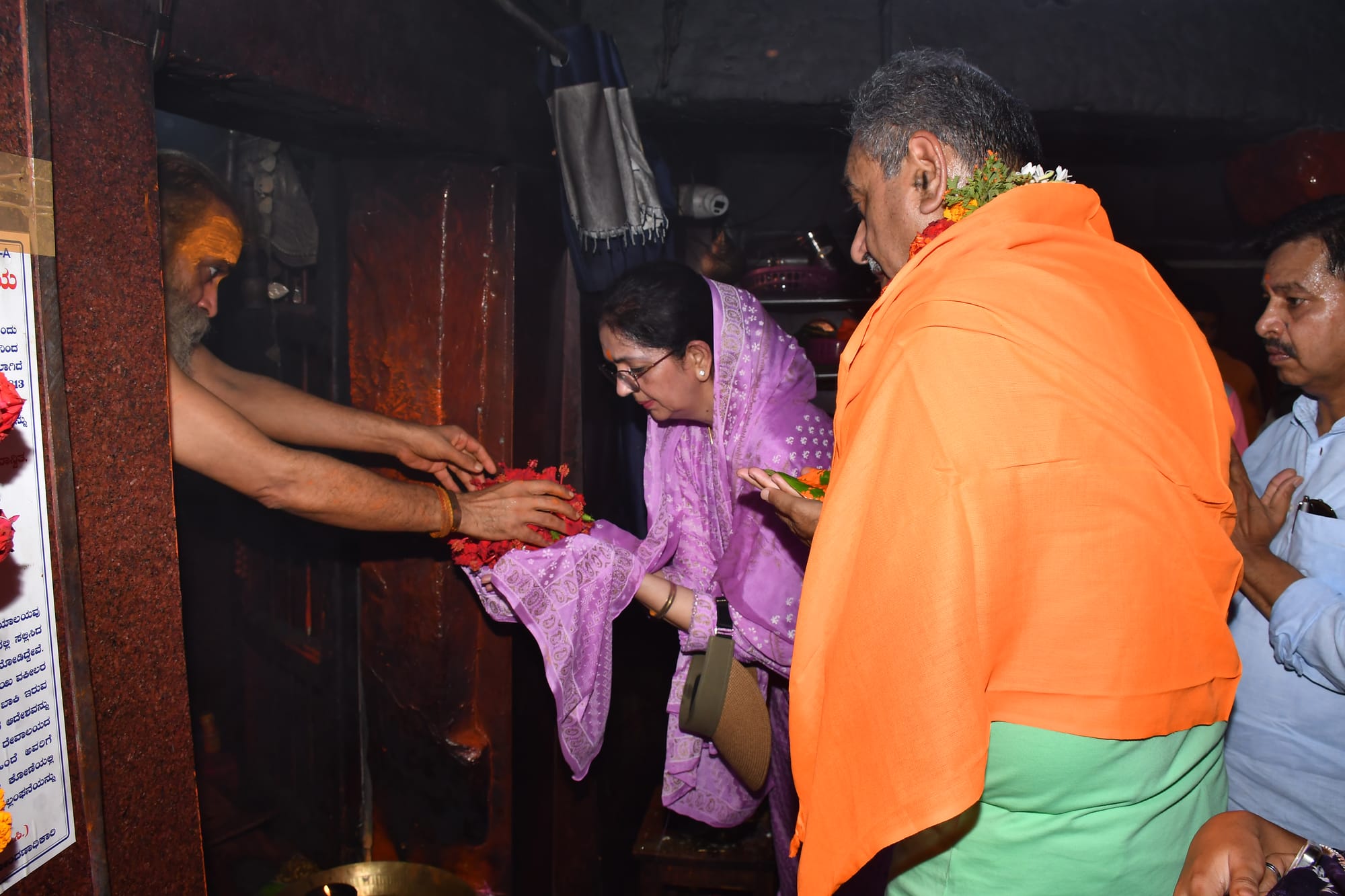
He also draped an orange cloth around my husband’s shoulders. As we ate the prasad, we were overwhelmingly cognisant of the fact that it was truly the divine energy of Hanumanji, that made it possible to climb those 475 steps.
Our guide advised us to take the front route of 575 steps, for the descent. The views of the valley and the Tungabhadra River were breathtaking. The weather was perfect, it was neither hot nor cold. There was a little shower of rain. It was as if the Lord was making sure that we were comfortable. Amidst chants of, “Jai Shri Ram! Jai Hanuman! Jai Bajrangbali!”, we made it downhill. I could not believe that I had done it! The experience was surreal; nothing short of it.
Next we went to the Virupaksa Mandir.
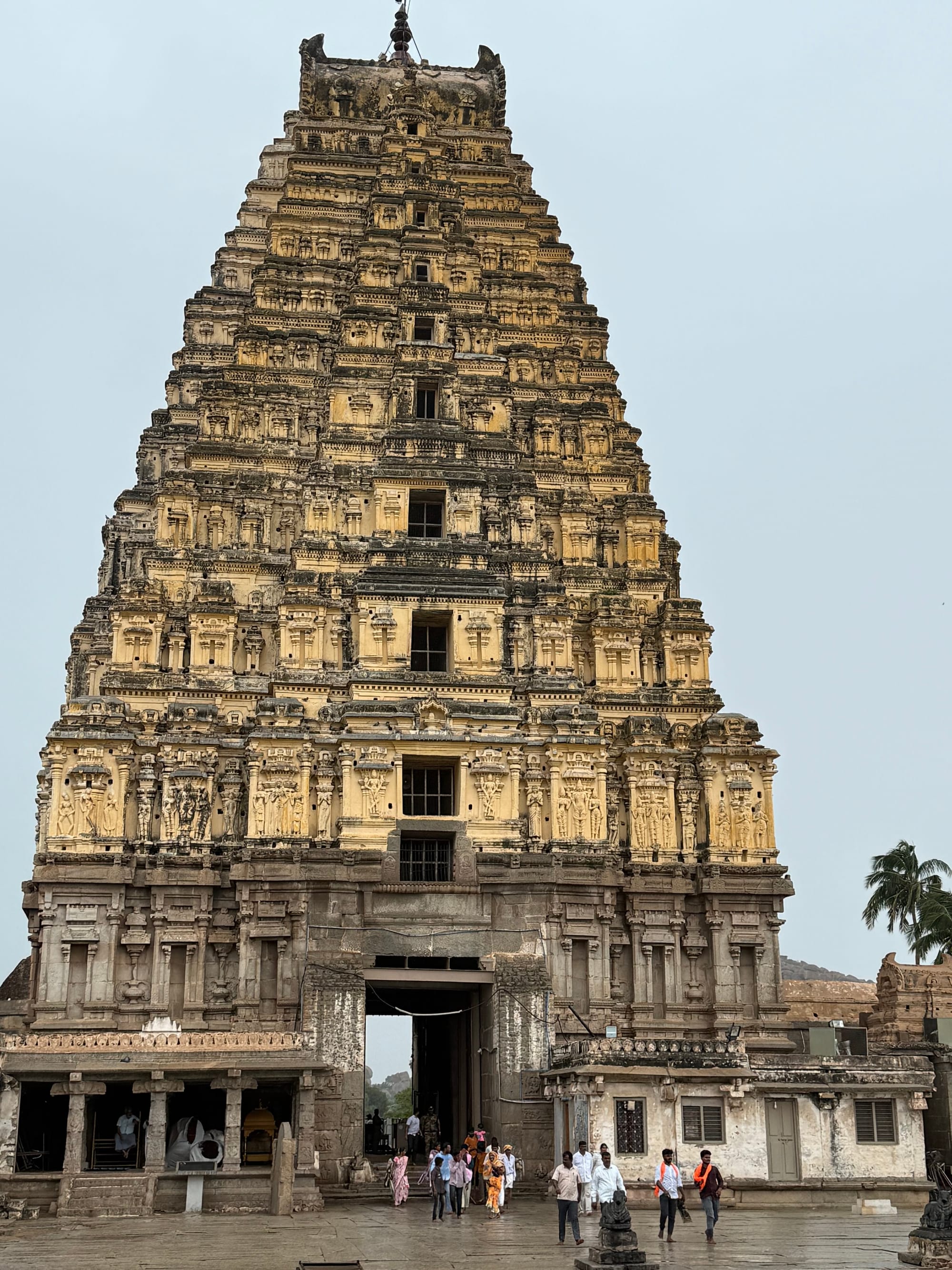
This is a Shiva Temple being the only ancient temple in Hampi, where Pooja-Archana is done. In all other temples the deity idols were disfigured or broken, so they are not worshipped anymore. But the Shivlingam in the Virupaksa Mandir stands unscathed. There is a Nandi statue outside the Mandir. I had read that when Sri Sathya Sai Baba was fourteen years old, he had visited Hampi with his family. Baba had refused to enter the Virupaksa Mandir and said that he would rather wait outside with Nandi. His brother, Seshama Raju, was annoyed at Baba’s attitude. Later Seshama Raju, saw Baba standing in place of the Shivlingam in the sanctum sanctorum! This enraged him, for he thought that his brother Sathya had entered into the Garbha-Griha from the back door. When he came outside, he saw his brother sitting calmly with Nandi! Shocked, he went back into the Garbha-Griha to find Sathya standing there. He went outside to check again. This zigzagging happened a couple of times, and this is when Sathya’s brother realised that Sathya Sai was Divinity incarnate. Ever since I had read this story, I had a deep desire to visit the Virupaksa Mandir, and here I was, in the immediate presence of the Lord! I was deeply overwhelmed.
Virupaksa means, Vi-Rupa-Akshi. Vi-Rupa means the opposite of Rupa; i.e. not beautiful. Akshi means eyes. This Shivlingam is symbolic of Lord Shiva with angry eyes, so his form is not beautiful, it is supposedly scary.
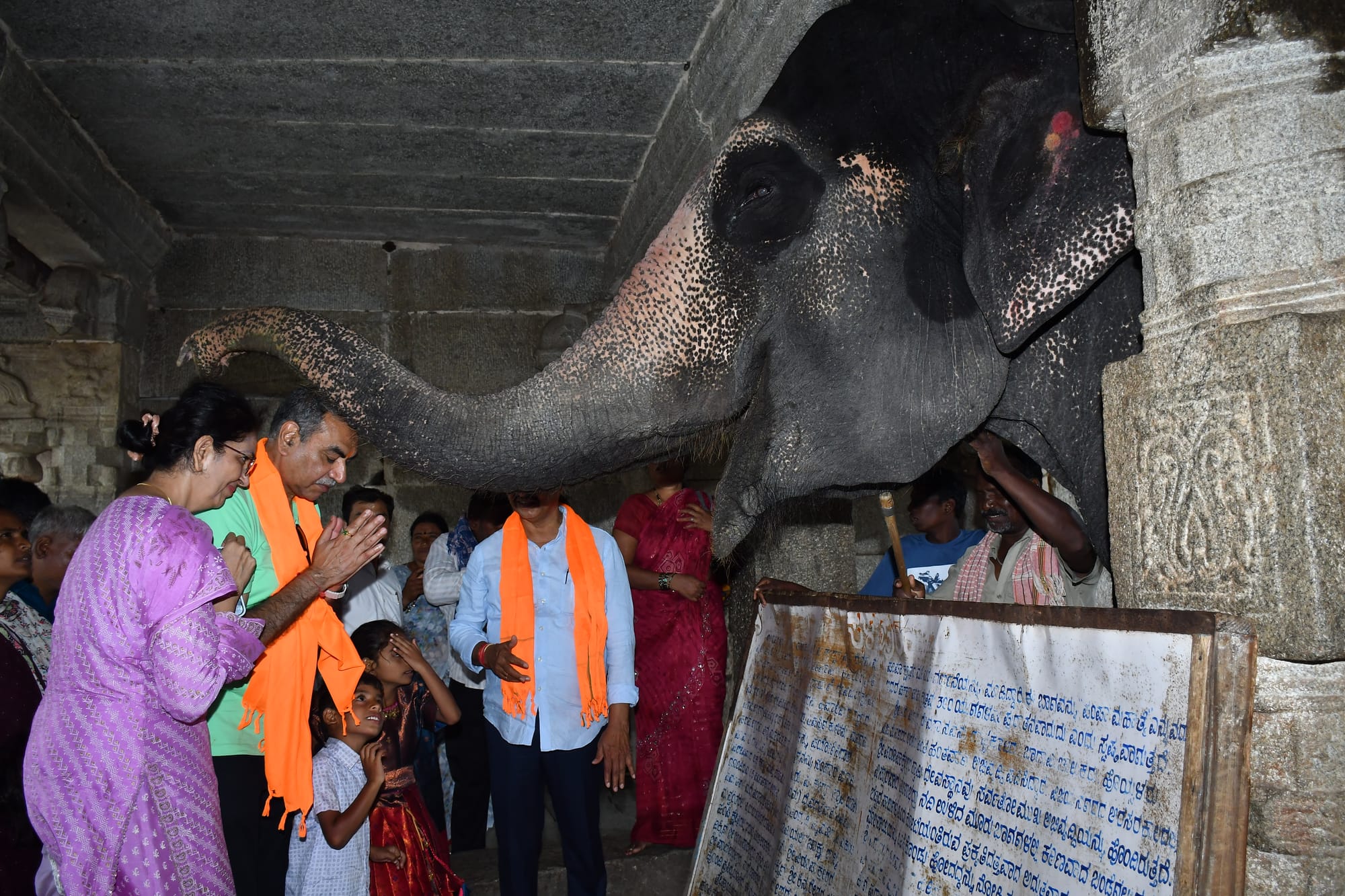
Shiva had sat in meditation here, after Sati had immolated herself. Parvati incarnated as Pampadevi and tried hard to awaken Shiva from his meditative state. She took help from Kama, the God of love, in her endeavour to woo Shiva. When Shiva’s meditation was disrupted, he opened his third eye in anger. His mere gaze, burnt Kama to ashes. Later Pampadevi (Parvati) was able to convince Shiva to marry her. Another divine experience here, was to be blessed by an elephant called Lakshmi, who lives in the Virupaksa temple and comes out only sometimes.
On the banks of the Pampa-sarovar is the temple of Pampadevi. Lord Shiva is resident here as Pampapati. Just a few yards away was the cave of Mata Shabari. The roof of the cave was barely three feet high. It was overwhelming to imagine that Mata Shabari sat and meditated here, and also that Bhagwan Ram and Lakshman had sat in this cave with her, as she fed them, wild berries. The cave was just an abstract arrangement of stones with some space in between, where perhaps even a five year old, couldn’t stand straight.
We also visited the Vitthala temple complex. There is a beautiful stone chariot of Garuda here.
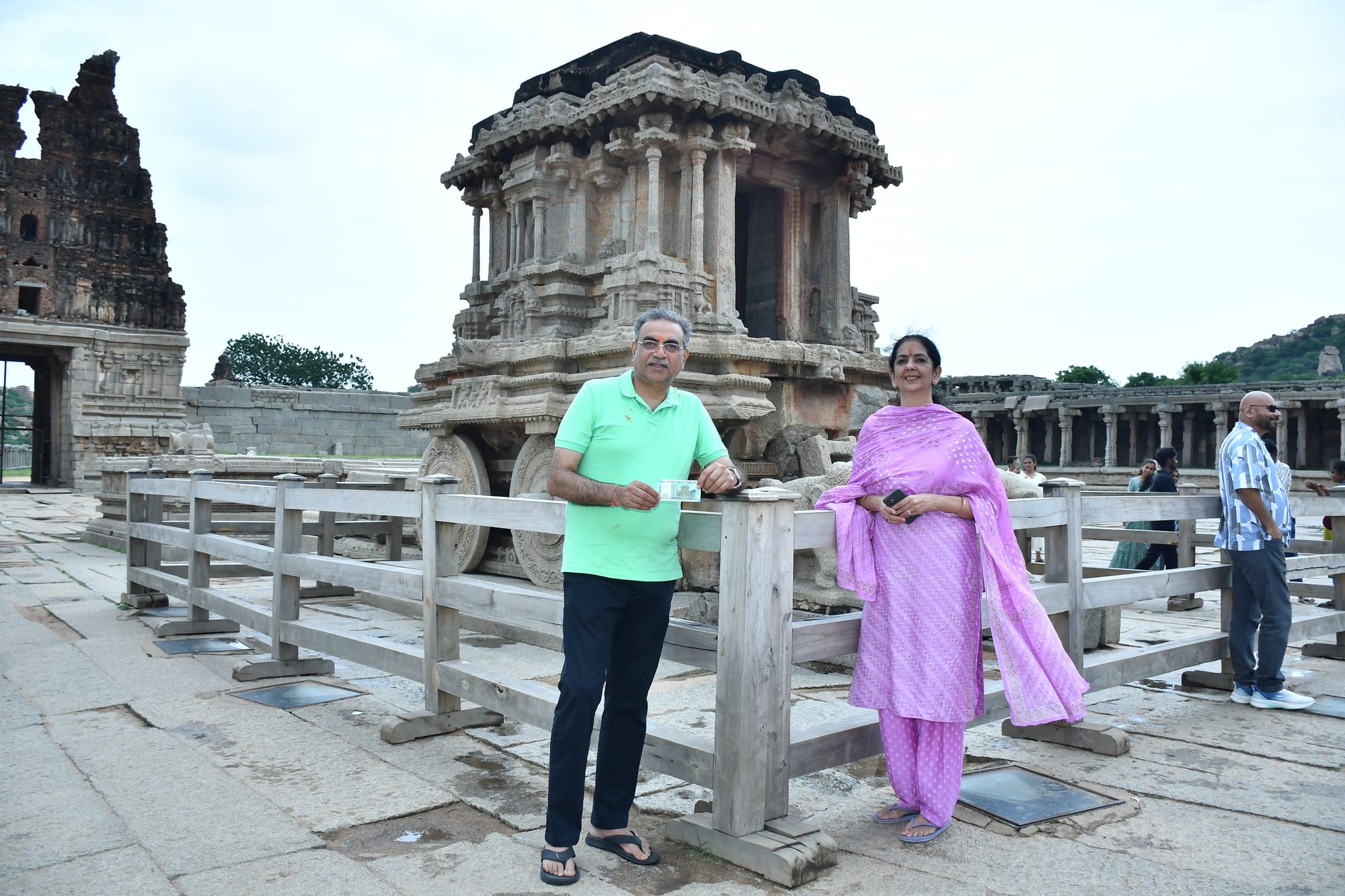
It is inscribed on our ₹50 currency note. There is a structure called Ranga-Mandapa or Nritya Shala, having 56 musical pillars or the Saptswara Stambhas, here. The pillars are made in clusters having varying thickness and density. When struck gently with a wooden stick, they emit sounds of different musical instruments, like Jal Tarang, Tabla, Dholak etc. The central portion of the Ranga-Mandapa had been left clear, for dancers to perform. Skilled musicians played music on those musical pillars. Presently, since the area was under restoration, QR code cards had been placed with each pillar. I scanned one of them and it said Jal-Tarang and also played for us the sound of a Jaltarang! It was amazing! These pillars are proof the super-advanced blending of the scientific, artistic and engineering skills in the Vijayanagar Empire in the 16th century.
Nearby is the Yantro-Dharak Hanumanji Temple where Hanumanji first met Ramji and Lakshman. Hanumanji’s image here, is placed inside a Yantra.
The following day we went to Puttaparthi for Guru Purnima. We try to be in Puttaparthi for Guru Purnima, every year.
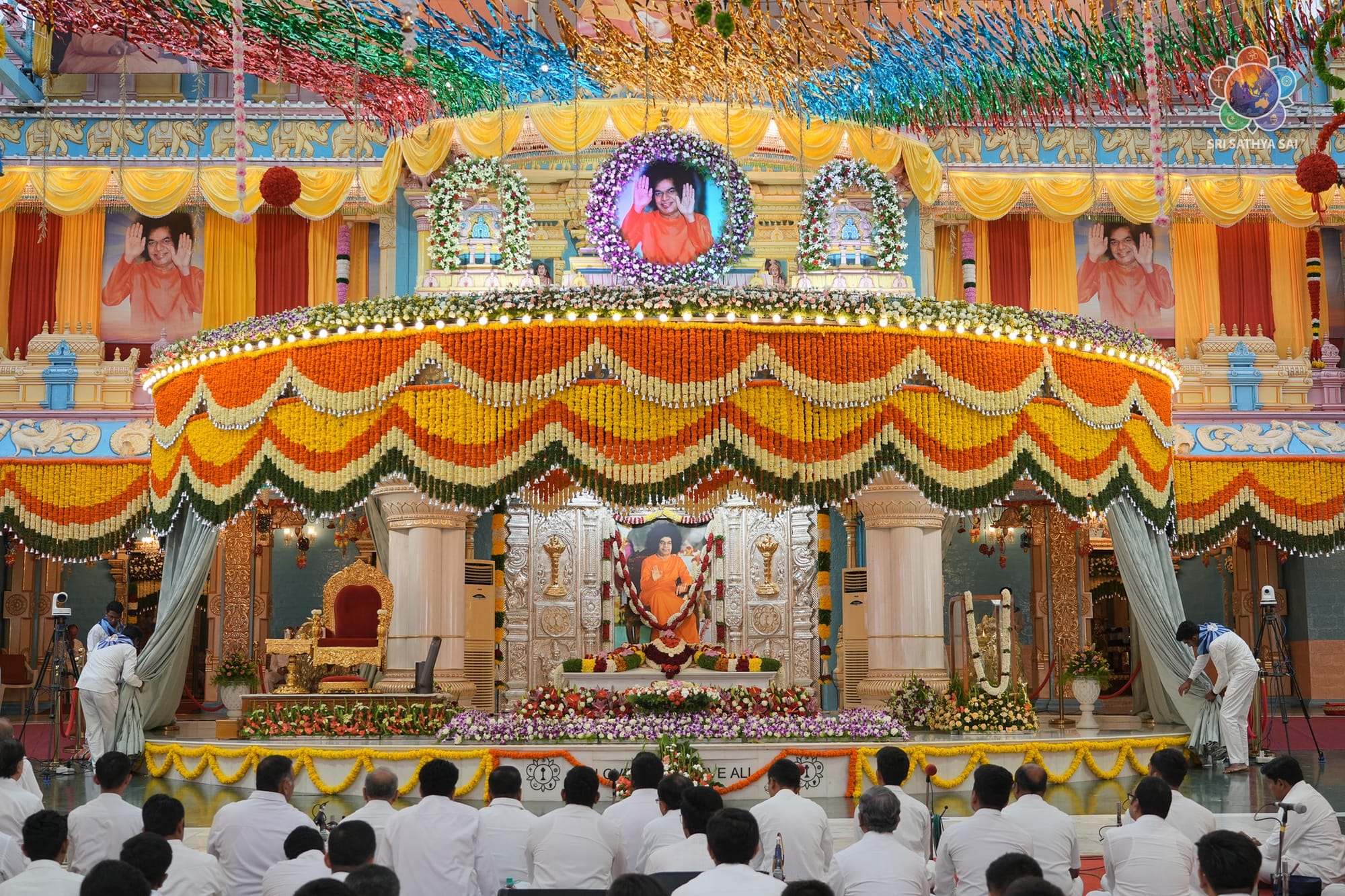
The yearlong celebrations for the upcoming 100th birthday of Sri Sathya Sai Baba are happening … there are talks, musical renditions of devotional songs, value-based skits etc. Our trip was suffused with divinity … Bharat has so much to offer, the divine vibes are soul-stirring.
This piece has been published in The Daily Guardian on uly 19, 2025 and can be viewed here https://epaper.thedailyguardian.com/view/2731/the-daily-guardian/8
Dear Reader, do subscribe to my blog to receive an email with the link to every new article, as and when I publish it. Feedback is always welcome. God Bless!

Comments ()