
Global Education Summit 2025 – Neurodiversity to Neuroplasticity
Each one of us is neurodiverse, in peculiar ways. We all have our idiocies; let’s have faith in the power of neuroplasticity, and change the shape of education in the country. Let’s do the good work, simply because it is good to do good work.
(By Priya S Tandon, with inputs from Vidya Praveena) Re-blogged from the orignal published in the Acadnews Academic Journal.
The Sri Sathya Sai Vidya Vahini, a unique Ed-tech platform that provides value-based teaching material, has been involved in creating educational content for school children since 2012. This content is uploaded onto the Prime Minister’s DIKSHA Portal. It comes in the form of Teachings Aids, Learning Aids, Learning Teaching Materials, etc., accompanied by multi-media aids. At the behest of the Ministry of Education, Sri Sathya Sai Vidya Vahini (SSSVV) started preparing content, appropriate for inclusive classrooms in January, 2022.
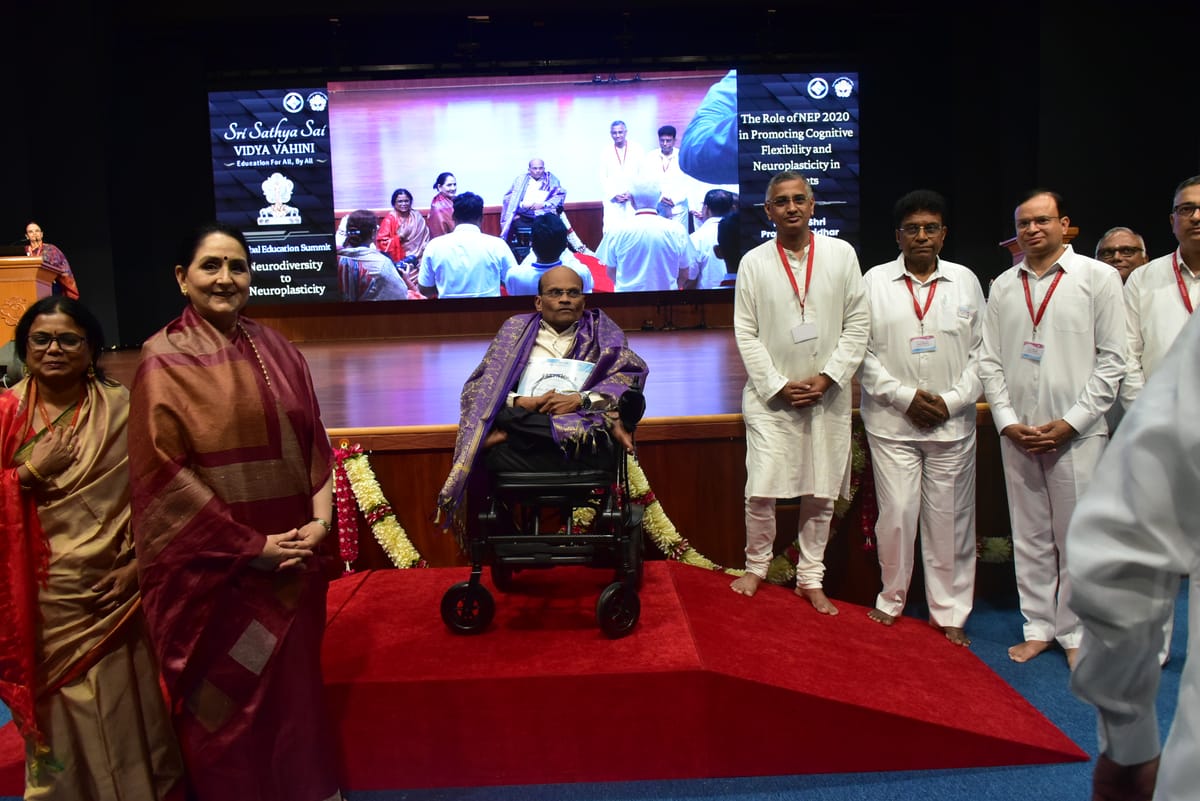
The Global Education Summit – 2025 was hosted, from June 25 to 27, 2025, in the hallowed precincts of Prasanthi Nilayam, Puttaparthi, the abode of Bhagwan Sri Sathya Sai Baba. The venue was an impressive, world class facility called the Sai Hira Global Convention Centre. This was built by philanthropist Ryuko Hira from Japan. It has world class amenities and infrastructure to hold conferences and seminars. The topic was ‘Neurodiversity to Neuroplasticity’. Neurodiversity, refers to the concept that neurological differences are natural variations of the human brain, rather than deficits. Neuroplasticity, refers to the brain’s ability to reorganize itself by forming new neural connections throughout life. The summit commenced with a Pre-Summit Workshop titled ‘Cognitive Education for Diverse Learners – The Missing Piece’.
The workshop on Day 1, began with the guest of honour, Dr. Jeanne Zehr, Director of Feuerstein Programs – North America, giving a detailed walkthrough of the Feuerstein Method, a globally recognized cognitive intervention system used in over 40 countries to enhance learning potential for anyone from ages four through adulthood. She showed how the Feuerstein tools could be implemented in diverse settings – from individual sessions to classrooms, to address a wide range of needs, including ADHD, autism and recovery from trauma. Dr Zehr presented case-studies to show improved cognitive and emotional outcomes, in children and adults. The method offers a hopeful and structured pathway to unlock human potential, making it both a scientific tool and a humanitarian gift.
Dr. Zehr then elaborated on ‘Cognitive spectrum’ as the range of cognitive abilities and processes that individuals can experience. It encompasses various aspects of cognition, including perception, attention, memory, learning, problem-solving and decision making. Improving cognition would improve learning. She showed some insightful ways in which it can be achieved.
Dr. Onita Nakra, Educational Counsellor, The American School of Dubai, UAE, explored the concept of Cognitive Education, a teaching approach that prioritizes systematic thinking, problem-solving and learning processes over rote content. She demonstrated that thinking can be taught and that intelligence is dynamic, shaped by both cognitive structures and mediated learning experiences.
Day 2, featured a series of talks, panels and interactive sessions exploring inclusive education, cognitive diversity and transformative pedagogies.
The official proceedings of the Global Education Summit 2025 on the theme, ‘Neurodiversity to Neuroplasticity’ commenced with the lighting of the lamp and a mellifluous performance by Kum. Menuka Paudel, a gifted visually impaired singer and recipient of the golden mic at the Indian Idol season 14, in 2023-24.
The Managing Trustee of the Sri Sathya Sai Central Trust, Sri RJ Ratnakar in his inaugural address, seamlessly bridged ancient wisdom and modern neurosciences, using captivating stories of Prahlada and Abhimanyu to illustrate the power of neuroplasticity.
The Director of Sri Sathya Sai Vidya Vahini, Ms Karuna Munshi, highlighted the remarkable accomplishments of Vidya Vahini, showcasing its profound impact and contributions in the field of education. In the process, she demonstrated what lofty goals can be achieved by a dedicated bunch of people, who are volunteers, having their own work life and family, living in various parts of the world connected only through love and a shared purpose of serving in the divine mission of our beloved Lord Sri Sathya Sai Baba, to work for a cause we all believe in.

Dr Srividya Sridhar from the Project Management Team, Inclusive Education Programme of SSSVV, shared insightful strategies for fostering inclusive education. She showed that by integrating these approaches, educators can create an inclusive learning environment that caters to diverse needs, promoting equitable access to quality education for students.
Dr Srividya also highlighted the Sri Sathya Sai Vidya Vahini’s Inclusive Education Programme’s initiatives including:
- Developing accessible apps
- Foundational braille and foundational ISL
- Customised DIY activity kits
- Action Research papers
- Feuerstein Instrumental Enrichment Programs
Saurabh Saksena, from the Project Management Team, Inclusive Education Programme, emphasized the importance of creating an inclusive environment where children of all abilities can belong, learn and thrive. His message underscored the importance of supportive ecosystems for every child to grow and succeed. He emphasised on the need to appreciate and cherish what we have, rather than focus solely on what’s different from our expectations. He spoke about the training programmes being developed by SSSVV to empower children with diverse disabilities to achieve as much independence as possible, while also equipping teachers, parents and caregivers with the tools to support them on that journey.
Dr Jeanne Zehr in her summary of the pre-summit workshop mentioned a NY Times article which said ‘experts have been wrong’ and medication on its own is not the answer. The learning strategies she highlighted were ‘Challenge and Novelty’. i.e. challenge the children and give them novelty in the form of new experiences to stimulate curiosity and engagement. Remember the power of 3 – change yourself, give thinking time to reply and follow up with thought provoking questions.
Prof Dr Indu Kumar, Head – Dept. of ICT – NCERT-CIET, and National coordinator of DIKSHA pointed out the importance of recognising differences in thinking, learning and behaviour. She emphasised the need to plan inclusive learning experiences from the start, leveraging neuroplasticity to enhance learning to cater to diverse learners. She said that different individuals have unique ways of processing information, experiencing the world and expressing themselves. The Universal Design for Learning or UDL, caters to these diverse needs by offering multiple options for presenting information, engaging students with different kinds of material and helping them demonstrate their understanding.
The presentation by Shri G. Balasubramanian, Former Director (Academics) CBSE, explored the future of educational leadership with a focus on neurodiversity, neuroplasticity and the need to break away from conventional models. He propounded promoting new and more effective ways to lead and ultimately transform the education system to become inclusive and better serve diverse learners. He critiqued traditional leadership models for their rigidity, lack of inclusivity and failure to nurture cognitive growth. Instead, he advocated for transformational leadership that embraces learner-centred pedagogies, customized curriculum designs and brain-based learning. The overarching message was that educational leadership must shift from standardized models to a more humanistic, adaptive and inclusive approach that celebrates diversity in learning. He concluded by saying that Neurodiversity focuses on the learnability of the learner, not on the learning or the teaching. Neuroplasticity moves the focus from the landscape of the school to the mindscape of the school.
Dr Bharati Kaushik, Professor CIET-NCERT, led an engaging session on inclusive education, guiding us from resistance to reality. She rightly identified that resistance stems from the fear of the unknown, rigid beliefs and systemic constraints.
Smt. Lakshmi Sarkar, an occupational therapist from Oman, provided valuable insights into neuroplasticity, its underlying principles and practical applications. She emphasised that any tool can have both beneficial and detrimental effects, and hence needs to be used with proper understanding.
Dr Udai Kiran Nori, Head of Dept. of Maths & Computer Sciences, SSSIHL, Prashanthi Nilayam, put up an engaging presentation on strength based learning for neurodiverse students.
A panel discussion was later moderated by Smt. Mallika Ganapathy, a consultant educator. She featured expert insights on the role played by early intervention in Neuroplasticity in child development and emotional regulation as well as how to achieve inclusivity in schools. The expert panellists were Mrs Lalitha Ramanujam (Director, Alpha to Omega Global School), Dr Prof Venkat Lakshmi (Prof. and HOD of HDRC, Maharani Cluster University), Dr Tarishi Nemani (Consultant, Paediatric Neurologist) and Mrs Jayashree Ramesh (Director, ASHA). Smt. Lalitha Ramanujam, said that there is no learning disability. If at all, there are teaching disabilities because teachers do not know how to teach a child with special needs.
Day 3, began with soulful prayers by Kum. Sapna Soundararajan, an autistic multilingual Carnatic, light music singer.
Prof Viswanath Kumar Ganesan (Adjunct Faculty IIT Madras and Principal Scientist TCS), shared a personal story that inspired his work on adaptive engagement of neurodiverse individuals in employment pathways, highlighting his and his wife’s efforts to create inclusive opportunities.
Padma Shri Prof MK Sridhar (Member NEP Drafting Committee), began his session expressing his heartfelt joy at being surrounded by like-minded individuals passionate about inclusivity. He felt that the traditional school education system had not focussed on the holistic development of children. In contrast he highlighted that the National Educational Policy 2020, is thoughtfully designed with brain development in mind, aiming to create a supportive ecosystem through trying to bring changes in the curriculum.
Through an engaging interactive session, Prof Sridhar explored the policy’s potential in fostering cognitive flexibility and neuroplasticity in students, showcasing its transformative impact on education. When asked about the key competencies of teachers to provide inclusive education, Prof MK Sridhar pointed to the ‘Help Ever, Hurt Never’ quote by Bhagwan Sri Sathya Sai Baba. Surely, Baba’s teachings are applicable to all fields and are the solution to all problems. Dr Sridhar said Seva and spirituality are the fundamental competencies, and genuine love combined with age-appropriate pedagogy are the next set of competencies. Lastly, teachers should be sensitive to the uniqueness of the child and that sensitivity will lead to sensibility.

Col. Dr Narayan Ramachandran (Orthopaedic Trauma Surgeon) activities showcased the brain’s adaptability through some short, fun and enriching breaking-sessions. Brain tickling exercises titled, ‘Flex your Cortex’ were provided at some junctures by him. He used ancient Indian wisdom and games. If we cross our arms and hands across our chest and hold our ears with the hand of the opposite side; and then do squats, it opens up the cerebral cortex! I had often seen men, especially in the southern part of India, stand in front of the deity in a temple, and do exactly that. I never really understood what they were doing. I assumed that it was a way of asking for forgiveness. I had also heard that in our parents’ generation, the schools gave as punishment, to naughty children, something similar in which children were to hold their ears and do squats. It was called Muruga Bano. Suddenly it all fell into place. They were being made to flex their cortex!
Another way suggested to flex the cortex, was to type on your keyboard, the alphabet in the reverse order i.e. from Z to A. When he suggested writing one’s name with the non-dominant hand it was hard enough. He then said that if you try to write a mirror image of your name with your non-dominant hand and fail; then try writing your name with your dominant hand and watch the non-dominant hand glide automatically to write the mirror image of your name! Truly the brain is magical!
Dr Anupam Ahuja (Former Prof. NCERT and member IBE-UNESCO), delivered an insightful talk on indigenous approaches to inclusive education, emphasising the importance of knowing your learners and making it meaningful. She reminded us that the outcomes will not be uniform. But when there are inclusive classrooms, every child’s performance improves. She touched upon the need for curriculum localisation, community involvement and providing positive reinforcement.
Dr Sujata Bhan (Senior Prof. and HOD Special Education SNDT Women’s Education, Mumbai), provided a clear overview of the NEP’s foundational stage, providing significant paradigm and a transformative impact on education. She also emphasized on the benefits of going back to our roots and explained the Pancha koshas.
Prof Victoria Naomi (Former Dean Avinashilingam, Institute for Home Science and Higher Education for Women), discussed the multi-tiered system of support, highlighted its role in academics and behavioural enhancement with the help of graphs.
Ms Indrani Basu (Action for Autism, New Delhi), emphasized the importance of partnering with parents to support neurodivergent children. Parents have the maximum opportunity to expose the child to experiences and learning. Teachers should be the friends of parents and listen to them, acknowledge their journey, validate their experiences and offer reassurance.
She spoke about the importance of positive reinforcement. She said that teachers should share positive feedbacks with the parents and, replace the words ‘no’ and ‘but’ with ‘yes’ and ‘and’. She made some really profound statements. “A teacher is someone who makes himself/herself progressively unnecessary.” “Neurodiversity is nature’s norm – there is nothing called normal or abnormal … It’s only that it’s different.” If each one of us can be diverse in height, looks, colour, features … and all this only biologically or physiologically, not depending on our social status, financial strength, education, etc, it is equally possible that each one of us understands and learns differently.
She also said, “Parents are the first teachers. Teachers are the second parents!” If both sets of teachers and parents work together, then the children can reach for the sky!” How true! Don’t teachers often refer to their students as their children?
Sri Ajmal Jami (Visual Communication Professional, journalist and photographer), began his talk by praising the Vidya Vahini’s work, describing it as breathtaking. With inspiring real-life examples, he showcased the remarkable resilience and neuroplasticity of the spirit of individuals, who left a lasting impact on those around.
Dr. Dipti Gandhi (Founder & CEO, Muskan Foundation, Mumbai), while elucidating the concepts of neuroplasticity and its application in vision rehabilitation for neurodiverse children, offered valuable insights into brain adaptability and visual skill development.
Grp. Capt. Chandrashekhar Sreenivas, VSM (Retd.), Vice-President – Daily Operations, Bengaluru Airport, showcased a presentation of the airport with sensitively planned spaces for inclusivity. He showed a sensory room created for neurodiverse individuals at Bengaluru airport. This is probably one of the world’s best sensory rooms! The airport has earned a 5-star accessibility rating from SKYTRAX, and is recognised as one of the top 20 terminals, globally.
A beautiful Bharatnatyam performance was rendered by Kum Asiya Begaum and Kum. Rakshitha V., both visually impaired girls. Smt. Soumya Sanak & Sri Sanak Kumar Athreya (Founder Directors, Svarakshema Foundation, Bengaluru), put up an engaging music activity to show case how music is an effective learning tool.

The entire proceedings of the summit were speedily translated into ISL language, live on the stage by ISL interpreters Susheela Joseph and Priyanka Prasanth. Some photographs were taken by Gayatri Gupta having Down Syndrome. The Summit Anchors Srujana Shankar, Sandhya Shekhar, Vidya Praveena, Deepa Singh and Prachi Mahajan seamlessly strung together all the beads of the summit-necklace to perfection. Towards the end, Smt. Vidya Praveena gave a beautiful synopsis of the event. Sh. Tharanatha Kotian thanked everyone with love and gratitude.
The Global Education Summit – 2025 has touched many hearts. It has reiterated once more the need to appreciate what we have, rather than chase what we lack. Let us see every child not for their limitations but for their potential. Let us offer love before judgement, and support before instruction. Each of us has the power to touch a life, to include, to uplift. Let us not forget that we can heal, we can transform, as we serve with devotion. As our beloved Lord Sai says, “Duty without love is deplorable. Duty with love is desirable. Love without duty is Divine.”

A heart touching exhibition of some works of art by neurodiverse individuals titled, ‘Language of Love – Neuro Expressions’ were on display in the foyer at the Sai Hira Global Convention Centre.
Many new learnings have come our way. To mention a few: Thinking is teachable – education should integrate cognitive strategies; not just subject matter. Teachers should act as mediators between the stimulus and student, to make the learning process an intriguing and stimulating one.
All of us at SSSVV are volunteers! We are a conglomeration of content creators, pedagogy experts, language experts, multimedia creators, corporate professionals, homemakers and many more who found their niche at SSSVV. We are all connected online and work from our homes, at our own time. And a blessed bunch we are! Having read this, I hope your cerebral juices are flowing, your cortex is flexed and new dendrites are sprouting … And if your eyes have welled with tears and your heart yearns to do your bit too, by all means do it! After all, we at SSSVV are all volunteers and all you need to join us is love, time and commitment. Because education has to be for all the children; and all for the children. And together we can make all the difference.
And … just as the filmmaker makes the film, the film makes the film maker. Each one of us becomes a product of what we do in life. Our thoughts, words and deeds reflect in our persona. In God’s creation each one of us is neurodiverse, in peculiar ways. We all have our idiocies; let’s have faith in the power of neuroplasticity, and change the shape of education in the country. Let’s do the good work, simply because it is good to do good work. And the good work shall in turn, transform us into goodness incarnate. Jai Sai Ram.
This piece has been published in the Acadnews Network on July 14, 2025. It can be viewed here https://acadnews.com/global-education-summit-2025-neurodiversity-to-neuroplasticity/
If you would like to share your thoughts, I would be happy to read them!

Comments ()