
Holy Makar Sankranti
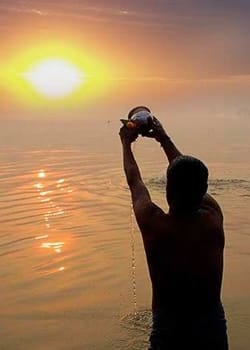
The sun does not need water or anything for that matter. But when we pour water, positioning the pot high up, the Sun’s rays fall on us through the stream of falling water and that is very beneficial for our eyes, bones and chakras too.
India follows the Luni-solar calendar. The solar calendar is used for determining the Sun’s position and all things related. Our horoscopes and most festivals are determined by the lunar calendar; while a few are determined by the solar calendar. Sankranti is the day when the Sun transitions from one Zodiac sign into the other. Makar Sankranti is believed to be the most auspicious of all Sankrantis. This is the day when the Sun moves from the Zodiac sign Sagittarius into Capricorn. Because Makar Sankranti is determined by the solar calendar, it always falls on 14/15th January. It marks the end of the khar maas and heralds the beginning of the auspicious days.
This festival is known by different names in different states. It may be called Magh Bihu, Pongal, Maghi, Shishur Saenkraat, Suggi Habba, etc.
The Sun is the most visible devta that showers us with heat and light every day. Sunlight is most important for our wellbeing as well as for plants because if there is no sunlight even the plants cannot perform photosynthesis. So if there was no sun, there would be no food. And if there was no food, nothing could survive on the earth. It is awe inspiring to reflect upon how silently, the Earth transitions from one Rashi (zodiac sign) into the next. It’s also inspiring to note how diligently and silently the Sun rises every day and showers its benevolence on us all. This is in stark contrast to how humans operate. If they give ten rupees to someone, they announce it to ten people.
It is considered auspicious to worship the Sun God on Makar Sankranti. We may offer water to the Sun from a copper vessel with a pinch of jaggery, kumkum and til on this day. This too is very scientific. The sun does not need water or anything for that matter. But when we pour water, positioning the pot high up, the Sun’s rays fall on us through the stream of falling water and that is very beneficial for our eyes, bones and chakras too. While offering water to the sun we may chant, ‘Om Surya Namaha’/ ‘Om Bhaskaraya Namaha’/ ‘Om Adityaya Namaha’ or the Gayatri Mantra.
Just as the Sun is benevolent towards all and showers us with sunlight, warmth and positivity, we need to emulate its spirit of giving to others without any discrimination. So it is considered a good practice to donate something to the needy on this day. This could be food, clothing, etc.
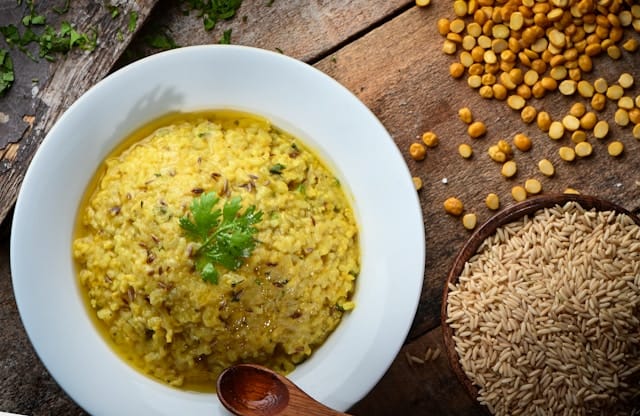
Traditionally khichdi is made on Makar Sankranti and offered to the Gods as well as eaten in most homes. My all-time favourite story to tell my granddaughters, is that of Chidiya aur kauwa. This is how it goes - Ek thi Chidiya, ek tha kauwa. Both were hungry. Chidiya brought dal. Kauwa brought chawal. Together, they made khichdi. Kauwa went to bathe before eating. Chidiya was so hungry that she ate all the khichdi. When kauwa saw this he ran after her to beat her. Chidiya screamed, “Hai main mar gayi Ram duhaayi!” Kauwa said, “Chidiya maayi chidiya maayi, kyun paraayee khichdi kaahyi?” Then chidiya said sorry to kauwa and made khichdi for him again! The children never get tired of hearing this!
Historically it is said that when Allauddin Khilji invaded India, there were times when people were not even able to prepare food for themselves. It is said that a wise yogi suggested to the people that they cook rice, dal and vegetables all together in a single pot. This would cook quickly and was a wholesome meal. Later it became a tradition to offer this on Makar Sankranti in all temples. Many people donate cooked khichdi or raw rice and dal in temples, in the memory of their ancestors.
My mother would always prepare khichdi of rice and chana dal on Sankranti morning and offer it in the Mandir at home. She would give it to us for breakfast. What I distinctly remember is that she would add a lot of ghee over the khichdi and serve it with curd. We were told that since we had consumed lots of gachak on Lohri the previous night, there is heat in the body and we need to cool it down by having khichdi. This is one of the traditions that I continue to observe in my home.
My favourite khichdi is Bajre ki khichdi which we make by soaking Bajra and Moth Dal for about 6 hours and then pressure cook it in the evening. The closed pressure cooker is left outside in the open at night. In the morning it is tempered with ghee and red chilli powder. Consumed with curd this is no less than a gourmet dish.
It is always interesting to understand how our festivals and traditions are woven around spirituality as well as physical and mental well-being. The concept of following up consumption of peanuts, til gachak and rewri, with khichdi on the next day to cool the stomach, is scientific.
There is a tradition of kite flying on Makar Sankranti. This is a way of getting people out in the open because on this day, the Sun is usually out and gives great relief after the gloomy and foggy days. When people fly kites in open grounds, this leads to automatic absorption of vitamin D. Also, during kite flying one looks upwards; this leads to looking into the vastness of the blue sky and the universe. This is another way of opening up our mental horizon. Even today when children are glued to computer screens we often tell them to go out and play in nature because being out in nature opens up the mind because the prefrontal cortex opens up to the expansiveness of nature and is prodded to think beyond its limits.
When the sun starts its northward journey from the Tropic of Capricorn in the southern hemisphere towards the Tropic of Cancer in the northern hemisphere it is said that the sun has moved into uttarayan or towards the Uttar disha (north direction). The day the sun marks its entry into the Makar rashi, the Zodiac sign of Capricorn, is Makar Sankranti.
India is basically a country of agriculture. Makar Sankranti is an occasion for farmers to offer their first produce of rice and dal in the form of khichdi to the Gods.
In the Mahabharata war, Bheeshma Pitamaha was wounded by hundreds of arrows piercing his body. He had the boon of dying when he wanted to. He lay on a bed of arrows for months, waiting for the Sun to enter Uttarayana. On the day of Makar Sankranti he chose to give up his body because he believed that if he died in Uttarayana, he would get Moksha.
The day the sun starts moving north, the direction associated with positivity and goodness, is a day to be celebrated. This leads me to think that if we also start moving towards positivity and goodness it would amount to us moving northwards, because the real journey northward happens inside of us.
Happy Makar Sankranti!
This piece is published in The Daily Guardian on 10.01.2026. https://www.magzter.com/stories/newspaper/The-Daily-Guardian/HOLY-MAKAR-SANKRANTI?srsltid=AfmBOopHWsgqy6alLu1k3gYEU9fRH9meVnQ61cpcyGqqkZk718FPXZn8
Do share further if you like the article! Please subscribe to my blog, if you haven't already. It would be a great encouragement for me and it's a free subscription. Thank you :)

Comments ()