
Karishye Vachanam Tava
If one pays heed to the commands of God with total faith and without any disputation, pro and contra, we need not bother about what others say. Obedience to God’s commands is a great guiding light for a beautiful life.
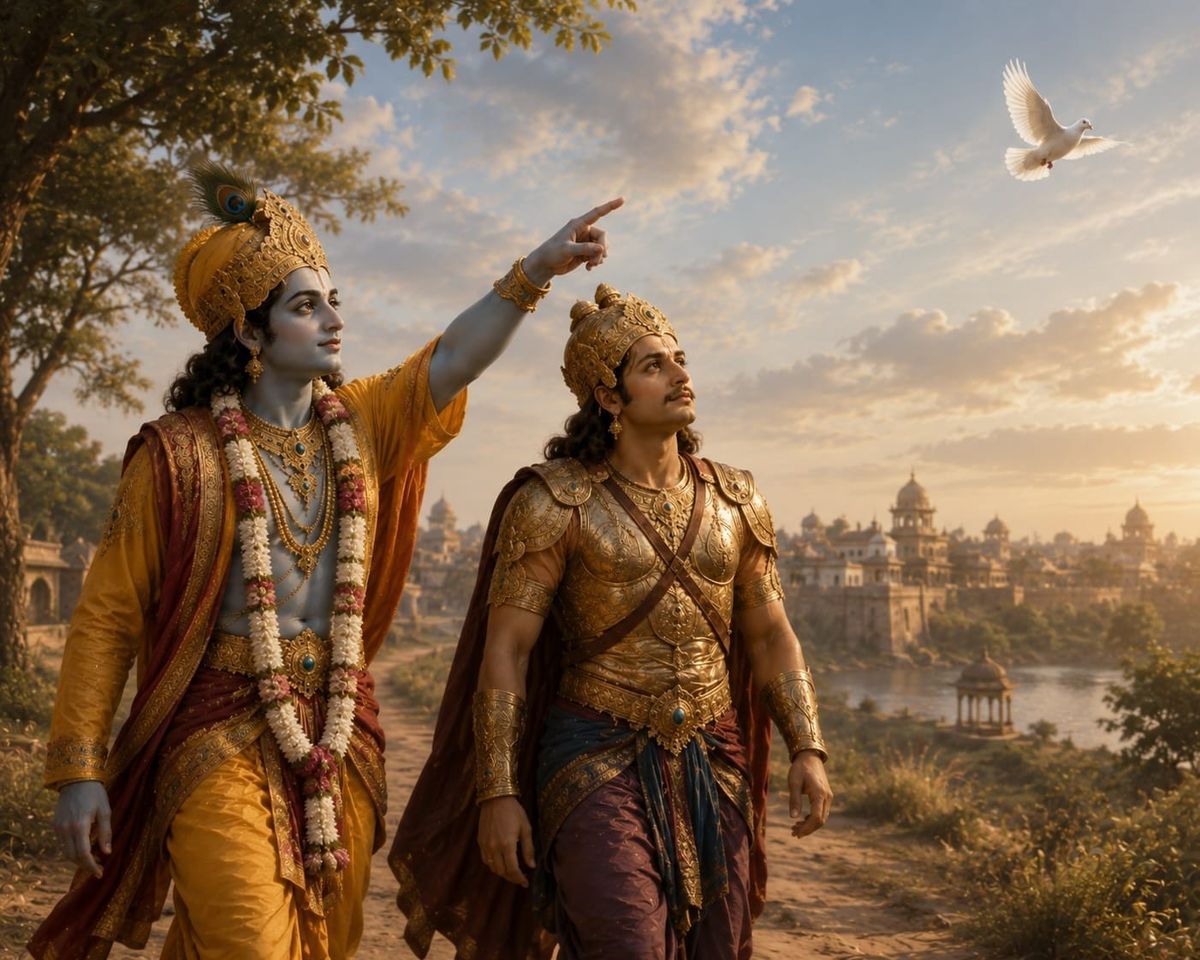
‘Karishye vachanam tava!!!’ is what Arjuna said to Krishna at the battlefield of the Mahabharata after the veil of illusion was lifted from his intellect and he realised that it was his duty to participate in the war and fulfil his dharma. It means ‘I will do your will!!!’ Complete obedience is what Arjuna pledged to Lord Krishna in verse 73 of chapter 18 of the Bhagavad Gita.
Once, Krishna and Arjuna were walking on the outskirts of Dwaraka. Krishna pointed to a bird flying over their heads and asked Arjuna, “Isn't that a dove?” Arjuna nodded, saying that it was indeed a dove. Suddenly, Krishna said, “No, I think it is a crow.” Arjuna nodded his head, saying, “It is surely a crow!” Just then, Krishna said, “Do you really think it’s a crow? It looks like a kite.” Arjuna agree promptly. “Of course, it is a kite.” At this, Krishna smiled and said, “Arjun, are you in your senses? Can’t you use your eyes and head? Look carefully. How can the same bird be a dove, a crow and a kite?” Arjuna replied calmly, “Who am I to dispute or disagree with you? You can turn the bird into a crow or a kite, even if it is not one. The safest thing for me is to agree with you and not argue. You know best.” Krishna gave the Gita Updesh to Arjuna after testing his unflinching obedience. Though it was a discourse given to Arjuna, it benefited mankind in a big way. It spells out how to live life. It spells out how one can perform one’s dharma while living in society. As Sathya Sai Baba says, “Head in the forest and body in society.”
The epics Ramayana and The Bhagavad Gita have numerous small incidents that can be used to teach values to children. The best part is that the values need not be spelt out; children grab the subtle learnings at a subconscious level.
Small children have to be taught to obey elders, not out of fear of punishment but out of love, respect and trust. A parent always wants the best for the child. The child should know that and instinctively follow instructions. A lot is being said about why children should not be punished or rebuked. It seems it damages their self-esteem. I differ. If parents and teachers do not correct a child when misbehaviour happens, who will? I recently heard about Brain Yoga. It seems in a brain yoga session, one is to hold the right ear with the left hand and the left ear with the right hand; pull the ears slightly downwards and do squats. Another exercise in Brain Yoga is to half-squat, bring the hands under the knees, then hold the ears. Well! This is what school teachers asked the students to do many years ago. It was a form of punishment when students were inattentive or undisciplined. My father used to tell us this about his school days. These movements open up the prefrontal cortex and activate the brain! Wow! Age-old Indian wisdom, which came for free, is now packaged in fancy wrapping paper and sold at a premium. Meditation was taught to children in Gurukuls, but is now taught for a price. Many middle-aged people have personal trainers who teach meditation. The same old meditation that was a part of regular learning in the times of the Rishis and Gurukuls! Old wine in a new bottle!
Why did we lose all that our ancestors knew? Because we did not listen! Obedience to our elders would have served us better.
What could be a finer example of filial piety than Rama? Rama was exiled for fourteen years on the day he was preparing for his coronation. Imagine the mindset of a man who had been told that he would be crowned king the next morning and was instead banished from the kingdom because his stepmother, Kaikeyi, asked for a long-pending boon from his father. To uphold the word and honour of his father, Rama prepared for exile. Rama was the epitome of obedience, or shall we say reverence! Rama said, “Raghukul reet sada chali aayi, praan jaaye par vachan na jaaye.” Meaning: I shall uphold the promise given by my father, even if that means giving up my life. Why would Rama say this? Yes, obedience!
Arjuna was also ever obedient to Krishna. He was the blessed one who got to live life in proximity to Krishna. He had Krishna to clear every doubt that arose in his head. Children need to obey elders. And what about elders? Who should they turn to when in doubt? If you have a Guru, that is a blessing …
I feel blessed that I grew up in the awareness of Sri Sathya Sai Baba. Numerous times, we had the blessed opportunity to sit close to Baba. His darshan, sparshan and sambhashana set the road map of living life in the awareness of God. While He was in the physical body, there were opportunities to hear the most profound truths from Him most casually. Now, while He is not in the physical body, his discourses on all topics under the Sun are available to read, watch and listen.
All of us know what is good and what is bad. We know the difference between right and wrong. In the absence of a Guru, the voice of conscience is the best guide. It gives the most sound advice. Yet we push it aside. Because we do not wish to obey.
If one pays heed to the commands of God with total faith and without any disputation, pro and contra, we need not bother about what others say. Obedience to God’s commands is a great guiding light for a beautiful life. Obedience is a habit or a virtue that can be cultivated only in childhood. It is a life skill that most people do not give enough importance to. One often notices parents giving instructions to children and children turning a deaf ear. They may behave as if they have not heard while continuing with whatever they are doing. Often, adults rattle off instructions, mindlessly unaware that the child is not even listening.
When obedience to elders is inculcated as a habit, perhaps it is easier to listen to the voice of God. Because God is our eternal parent. The voice of God becomes palpable around us if we are in tune with the divine. The voice may come to us from within, through a stranger, our child or grandchild … It’s like a spark that reveals itself when you are lonely or looking for guidance. The conscience is the voice of God within us. Kabirji said, “Jaise til mein tael hai, jyon chakmak mein aag; Tera Sai tujh mein hai, tu jaag sake to jaag.”

If each of us obeys the voice of conscience, we can become good humans. Good humans are much needed to save the world from the mess it is in. Each of us is collectively responsible for making a better world. I often remember the song “We are the world. We are the children. We are the ones who make a brighter day, so let's start giving …”
Do think about what part you can play in this.
[Dear Friend, if you like the article, please share it with others. Do subscribe to my blog if you haven't already. It would encourage me, and the subscription is free. Thank you 😊 ]
Published in The Daily Guardian on 04.07.2026 https://epaper.thedailyguardian.com/2026/07/03/e-paper-today-delhi-04-july-2026/

Comments ()