
Nav-Ratri ka Parv
This festival serves as a reminder that the girl child is as precious as the boy. It is also important to remember that while worshipping little girls as Goddess Durga we must also respect the other living goddesses around us.
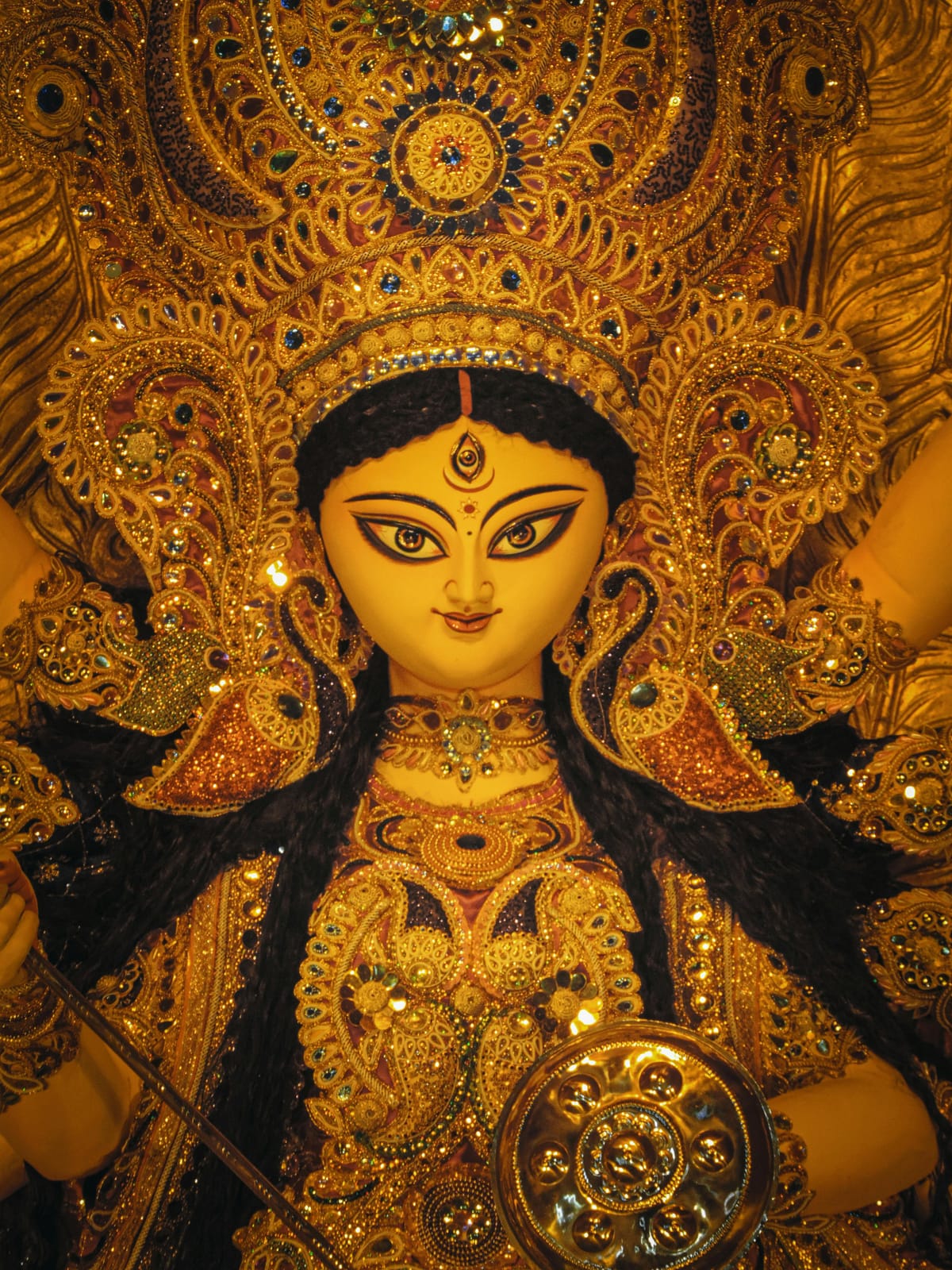
The festival season is just round the corner. Sharadiya Navratri begins on 22 September, 2025. It commemorates of the victory of Goddess Durga over the demon Mahishasura after nine days of gruesome battle.
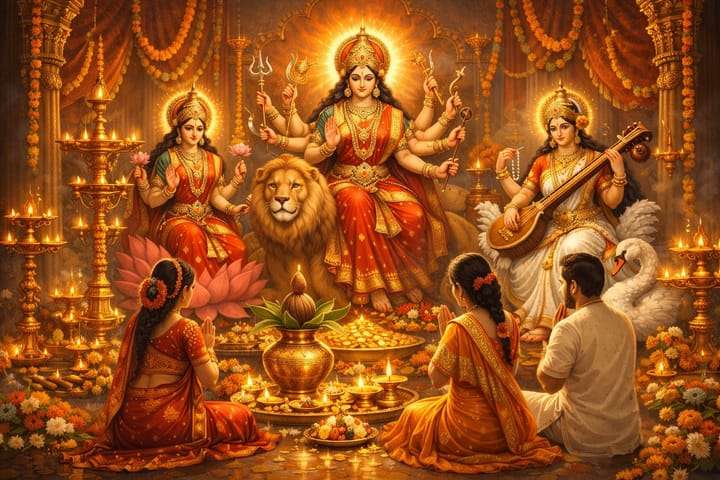
Goddess Durga is worshipped in her nine forms during the Navratri festival as Nav-Durga. Many of us do Ghatsthapna, by sowing Khetri of Jau (barley) and keeping a Kalash of water with mango leaves and a coconut on top. Jau was the first crop that was sown and cultivated by humans. To honour the memory of the beginning of agriculture we sow Jau and pray for blessings and prosperity. Coconut and mango leaves are symbols of auspiciousness.
On Ashtami or Naumi day, we worship prepubescent girls as little Goddesses. We wash their feet with water, tie mauli-thread on their wrists, anoint their foreheads with Kumkum and rice, offer them food (usually Halva, Puri and Channa) and give them Dakshina. Whenever I do Kanjak puja, I am overwhelmed by the thought that went behind starting this tradition. How far sighted our ancestors were! They probably knew that the girl child would be the lesser-favoured at some time or the other, so they created this tradition of doing Kanya Poojan to honour the girl child, bi-annually during the Navratri festival.
This festival serves as a reminder that the girl child is as precious as the boy. It is also important to remember that while worshipping little girls as Goddess Durga we must also respect the other living goddesses around us. These could be your mother, mother-in-law, sister, daughter, daughter-in-law, granddaughter, friends, neighbours or just any woman on the street.
A society's overall condition and progress can be decoded by examining the rights, opportunities and social standing of women. If there is gender equality, if there is no violence or abuse of women; if women have equal access to education, economic participation and freedom from discrimination, it gives a sneak peek into the core values that form the basis of a society.
God made everything in pairs. Man and woman are equally important parts of His creation. In our culture the woman is always accorded the first place. This is evident in how we address our deities. We say Radha-Krishna, Sita-Rama, Lakshmi-Narayana, Gauri-Shankar! How then could we ever think of women as the lesser half? The ills prevalent in the society are of recent origin. Navratri affords a subtle reminder to honour women.
Navratri is also a time when many people observe fasts. This too is a well thought out tradition. Navratri happens at the confluence of summer and winter. This is the time when our body needs to be conditioned for the upcoming season. Navratri fasting entails going off wheat, rice and tamasic food like garlic, onion, etc. The diet consists of Kutu ka Atta, Swank ke chawal, potatoes, pumpkins, sweet potatoes, dry fruits, fruits, cucumber, tomato etc. Cooking with sendha namak is a great detoxifier. If the fast is observed like a fast and not converted into a feast, by consuming Puris, pakoras and heavy sweetmeats, it is a great way to detox the body twice in a year.
The male aspect of Divinity in its omniscient, omnipotent form is Purusha or Shiva. The omnipresent female aspect is Devi, and is called Prakriti (nature). It is all pervading. It assumes various forms like humans, animals, vegetation, landforms, water bodies etc. The invisible divine energy in all of creation; the prana aspect is Purush. The gross body or visible part of creation is Prakriti. When Purush and Prakriti unite, life happens!
The Navratri is the period when we focus on honouring and adulating the Devi in her nine forms as Nav-Durga. Each day of Navratri is linked to a specific form of Goddess Durga.
1st- Shailaputri- Parvati is worshipped on the first day in her youthful, maiden form as Shaila-putri, the daughter of the mountain king, Himalaya. The unwed Parvati, desired and aspired for the greatest. She inspires us to achieve the highest state of consciousness.
2nd- Brahmcharini- As Goddess Parvati grew up, she had an intense desire to marry Lord Shiva. She performed severe penance for Lord Shiva to accept her as His wife. Brahm means divine consciousness and Charini signifies pure, celibate, impeccable conduct. Conduct suffused with divine consciousness is Brahmcharya. On the second day we adulate her for her impeccable conduct and one-pointed-focus on her aspiration.
3rd- Chandraghanta- The moon (Chandra) presides over the mind. The mind is restless and carries a cornucopia of thoughts. Ghanta means bell. The bell always produces the same sound. On the third Navratri we worship Parvati as one who conquered the restless mind and stabilised it at one point like the bell. And in that meditative state, she married Shiva.
4th- Kushmanda- Kushmanda means Ku+Ushma+anda or Small + warm + egg. On this day, we worship the Devi as Kushmanda, when she conceived and carried Kartikeya in her womb. The entire universe originated from the cosmic egg (Hiranyagarbha) that manifests from the boundless energy of the Goddess.
5th- Skandamata- On the fifth day, Devi Parvati is worshipped as the mother of Skanda or Lord Kartikeya. She is the embodiment of maternal affection.
6th– Katyayani - Devi Parvati in her anger against the demons had assumed the form of Katyayani. Her anger was for the cause of Dharma. In anger, Durga can cause destruction and imbalance in creation, in the form of natural calamities. On the sixth day we pray for her to have mercy on creation.
7th- Kaalratri- This is the form of Parvati akin to the dark night, that emerged to destroy the evil forces. It is the terrifying and destructive aspect of Shakti. On this day we pray to the Devi to help us overcome and destroy the vices in us so that we too can emerge victorious over them.
8th– Mahagauri – After destroying all that is vicious and demonic, the Goddess became calm, serene and beautiful. Goddess Mahagauri is that divine energy we worship on the 8th day. This day is popular as Durga Ashtami when we do Kanya/Kanjak Poojan.
9th- Siddhidatri- On the ninth day, the Goddess is worshipped as Siddhidatri – the bestower of supernatural powers, energy, happiness and wealth. Goddess Siddhidatri bestows us with material and spiritual success. She can make the impossible, possible. We pray for her grace.
Sri Sathya Sai Baba says, “The Vedas declare that where women are honoured and esteemed, there Divinity is present with all its potency. Unfortunately, today men consider it demeaning to honour women. This is utterly wrong and is a sign of ignorance. Sthree (woman) is Grihalakshmi (the Goddess of Prosperity for the home). She is hailed as Dharmapatni (the virtuous spouse). She is called Illalu (the mistress of the house) and Ardhangi (the better half). People gloat over petty titles conferred on them. But women have been conferred the highest titles, which are valid for all time.”
Do find time to read the Durga Kavach, Mahishasura Mardini Stotram or any Devi-prayer that appeals to you. The Navratri ends with Dussehra on Oct 2, 2025. Let’s pray together for humanity. Let us celebrate Navratri in its true spirit. Jai Mata ki!
Dear Reader, If you like the article do subscribe to my blog to stayed connected. Thank you!
Comments ()