
Sab Moh-Maya Hai
God neither comes nor goes. He was always present everywhere. The difference is in our feelings. When our heart is pure, we can see Him and experience Him. When our heart is impure, we cannot see Him.
There is a popular story of a man walking in the dark, holding a lamp to light up the path ahead. Suddenly, he stops because he sees a snake hanging from the branch of a tree just ahead of him. This scares the wits out of him. He turns around and hurriedly goes back. The next day, he crosses by the same way, under the same tree and sees a rope hanging from the same spot where the snake was. In a flash of realisation, he understands that the snake last night was not a snake, it was just a hanging rope! In that moment, the veil of ignorance was shattered! Maya (illusion) was cast away. And ignorance turned into knowledge!
When a child is born, his first cry says, “Kvaaaaa …” This translates to, “Who am I?”

This is the most pertinent question a spiritual seeker continues to ponder over throughout life. Quite often, when we are witnesses to someone’s journey of life coming to an end and are at the crematorium to attend the last rites, we hear, “Yahi sach hai. Baaki Sab Moh-Maya Hai. Aakhir mein to sabne yahin aana hai. Sab kuch yahin reh jaana hai. ” This feeling is called Shamshaan Vairagaya. It is a temporary phase of detachment or introspective renunciation experienced at a cremation ground while facing grief and sorrow. It makes one think about the impermanence of life and the inevitability of death.
‘Moh' means attachment. ‘Maya’ means illusion; it refers to the unreal nature of worldly things. Maya controls the mind by casting a veil over it, hiding reality. The mind honestly believes the unreal to be real. This is because the human mind is unable to see through the Maya-Jaal, the veil of illusion. Maya is powerful. It can literally drive a man mad.
Maya and Yama are deeply connected. Maya ensures that individuals identify with the physical body and the material world and thus remain bound to the cycle of birth, death and rebirth. Death is governed by Yama, the God of death. When Yama comes, the illusion created by Maya is finally shattered.
To keep away from the clutches of Maya, man has to turn to God. Because only God can overcome Maya. Maya can be thought of as a nartaki (dancer). Maya makes us do Nritya (dance) to its tunes. If and when you gain full control over this na-rta-ki, your life becomes a ki-rta-na (the reverse of the word nartaki). And then one can experience living in the awareness of God!
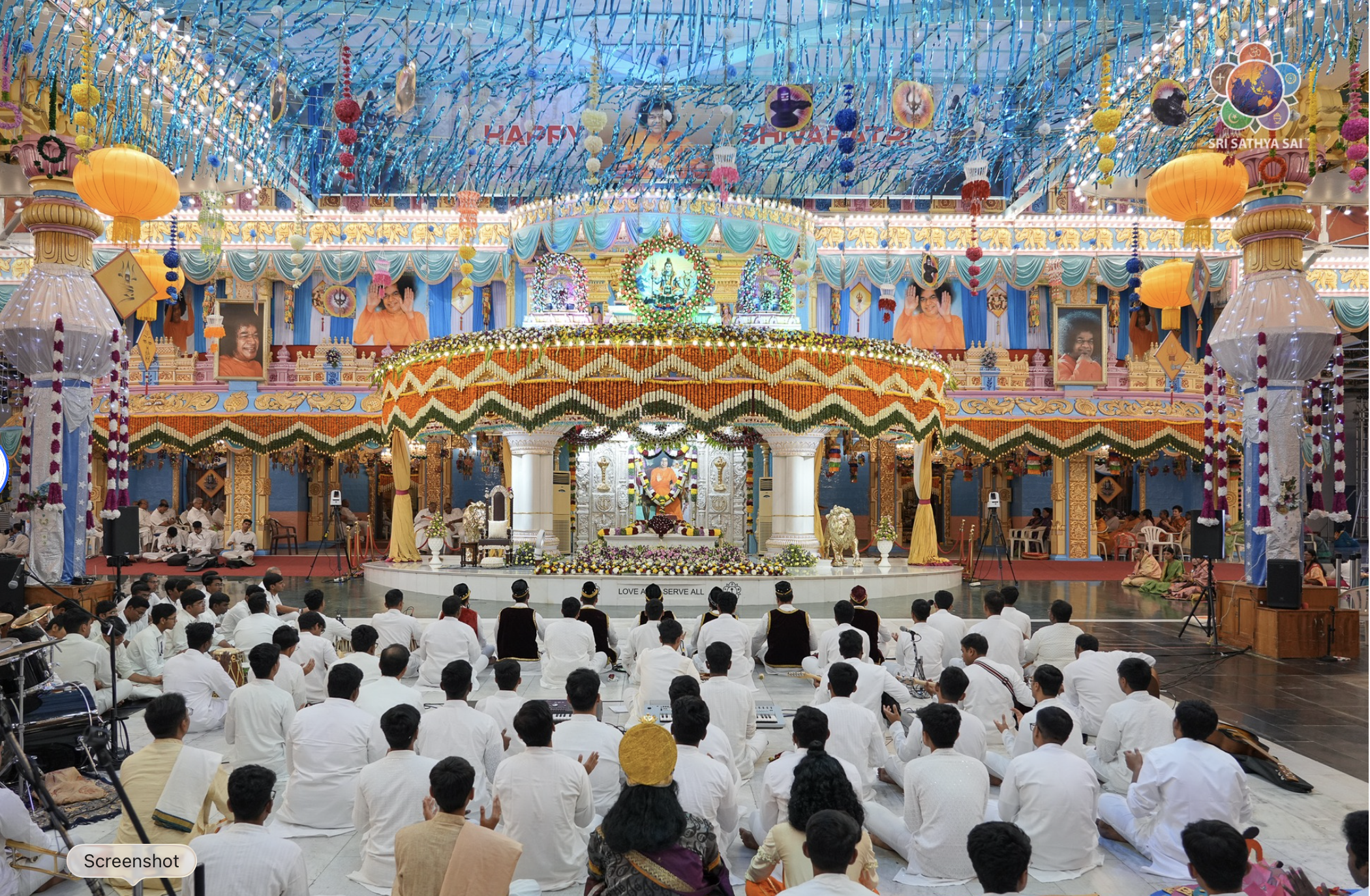
Only by God’s grace can we pierce the veil of Maya. People often attend Satsang. The popular belief is that Satsang denotes the company of good people and listening to their teachings. But Satsang is Satya-ka-sang. Or being in the company of the eternal truth. Sri Sathya Sai Baba says, “Satsang means living in Divinity that is changeless, attribute-less, formless, immortal, infinite, ever united, and unique as one only. To live always in divine consciousness is the real purport of Satsang. Living in the awareness of Divinity is Satsang.”
God is all around us. We are unable to see or catch the air around us, but we cannot deny its presence. Similarly, we cannot deny the existence of the omnipresent, omniscient being, merely because we are unable to see and experience it. Consciousness is God, and it does exist!
While in a temple or in meditation, we may feel that God comes to give us darshan. But really speaking, God neither comes nor goes. He was always present everywhere. The difference is in our feelings. When our heart is pure, we can see Him and experience Him. When our heart is impure, we cannot see Him. It’s like when your Wi-fi is on, you can log in to the internet. When your heart is pure, you can feel the divinity all around.

Man sees all objects in the world with his physical eyes. The Vedas say that whatever is perceived is liable to perish. Neither the eye that sees, nor the object that is seen, is permanent. All creatures are endowed with eyes. But did you ever wonder what the unique value of the eyes possessed by humans is? What is the unique significance and purpose of human existence? Having been born human, it would be unfortunate if humans were content with just physical vision. We must endeavour to acquire Jnana-netram (the eye of wisdom). Without wisdom, what is the use of one’s intelligence or one’s mental prowess? What is a man worth if he is unable to recognise the divinity within him? Man is the jewel in the crown of God’s creation. That is why the scriptures have praised the noble virtues that man is capable of manifesting. One who is lazy and doesn’t make use of his physical aptitude is called Aalasi (lazy). One who does not make use of the opportunity of human-life to connect with God is called Abhaaga (unlucky). Let’s not be Aalasi or Abhaaga; let’s strive to be wise.

Let us strive to acquire the eye of wisdom. The physical eyes are inept to see the highly subtle mind. How can the eyes that are unable to see the mind, see the Atma? To see the Atma/soul we need the Jnana-netram. This can be endowed only by God’s grace. And Bhakti (devotion) is the way prescribed.
Bhagawan Sri Sathya Sai Baba says, “Bhakti is not limited to performing worship. We must offer ourselves to God! We must hold on to love in all situations. This is Bhakti.”
When we go through life and its innumerable ups and downs, we slowly realise that the pleasure derived from all worldly things is transient. But the pleasure and peace derived from Bhakti are permanent. That ecstasy is different. People who get drunk on alcohol, have a high for a few hours and then face a hangover. But those who get drunk on the name of the Lord, on the nectar of Bhakti, are forever drunk! And they are the ones who rise above Moh-Maya!
The world and all its manifestations are ephemeral. Let us seek what is eternal. We all know what it is. But we are so immersed in the ephemeral that we do not find time to seek the eternal.
We often pray and ask for this, that and the other from God. In the larger picture, these worldly things are just tinsel and trash. Bhagawan Baba would often give his devotees little things that they asked for. Some would ask for a child, a job, a daughter’s marriage, a manifested ring, etc. While granting these wishes, He would say, “I give you what you seek so that one day you will seek what I have come to give.” And He came to give us the experience and the bliss of living in the presence and awareness of divinity. The rest is all Moh-Maya! Steer clear of it!
Dear Reader, if you like this piece, do share it further. It would help me to increase my reach. Please subscribe to my blog. It's a free subscription. You shall receive an email whenever I post something on the blog. Thank you.
Published in Daily Guardian https://epaper.thedailyguardian.com/2026/02/22/e-paper-today-delhi-23-february-2026/


Comments ()