
Nourishing Childhood Bonds on Rakhi
Properties shall get left behind when we die. Let us not carry the bad karma of bitter relationships with us. While sibling rivalry is much talked about, sibling love is rarely celebrated.
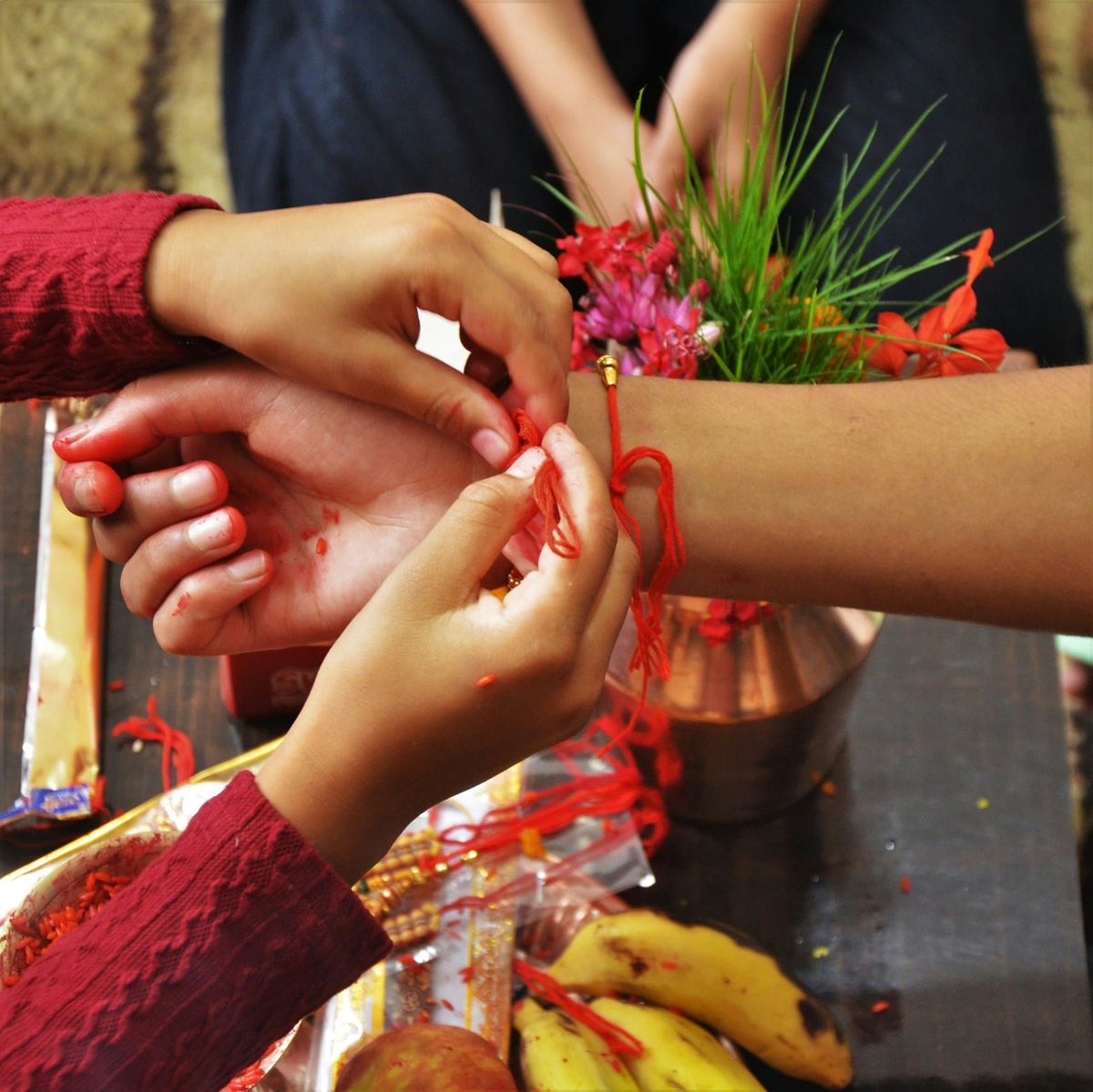
While the month of Sawan/Shraavan celebrates love and romance, it has a day earmarked for celebrating sibling love too. Rakhi or Raksha Bandhan falls on Poornima, the full moon day, in the month of Sawan. Our scriptures tell of the time when Krishna was going to war, and his sister Subhadra tied a thread on his wrist and blessed Him. She said, “May you emerge victorious and always shine like the full moon of Poornima!” This is the first documented Raksha-ka-Bandhan or Raksha-Kavach tied by a sister to her brother’s wrist.
Another popular incident is of Draupadi, who tore off a strip from the pallu of her saree and used it to bandage Krishna’s bleeding finger. Many years later, when Draupadi stood in the midst of the Kauravas, Pandavas and Kuru elders and beseeched her five husbands and other elders for help, no one was able to save her. Her husbands had been pawned off in the game of dice; they cast their eyes low and looked helpless. At that time Krishna repaid the debt of the strip torn off Draupadi’s pallu by saving her dignity. Krishna stalled one of the ugliest scenes of our history, the Draupadi-Cheer-Haran.
India is a land with many temples, old and new. Most temples have idols of Radha with Krishna, Gauri with Shankara, Lakshmi with Narayana or Sita with Rama. Others have single idols of Hanumanji, Maa Gauri in her unmarried Shail Putri form, Maa Durga, Shani Dev, etc.
There is only one temple that celebrates sibling love. That is the Jagannath Temple at Puri, which has idols of Krishna (as Jagannath - Lord of the Universe) with his brother, Balbhadra/Balarama and sister Subhadra. To date, when the Jagannath Rath Yatra begins, Subhadra ties Rakhis on the wrists of her brothers Krishna and Balarama before the procession begins.
Rakhi is a sacred thread; a Raksha ka Bandhan, tied by a girl on her brother’s wrist. It comes with a prayer for the good health and long life of the brother. The brother, in turn, promises to protect and guard the honour of the sister. In present times, when girls are doing all that boys do, I doubt if there are any promises for protection, etc. At different times in life, siblings need each other, in good times and bad. But it is wonderful to pray for each other and pledge to stand by each other through thick and thin.
My childhood memories are dotted with Rakhi days, when my parents gave my two younger brothers money to give to my sister and me. The boys were always sore about it. For them, Rakhi was an unfair festival that favoured the sisters. Well! They still give us money, but it’s money from their own pocket, and now they give it happily! On Rakhi day, when siblings get together and celebrate, parents feel happy. And as we get on in years and our parents are no longer in this world, it’s therapeutic to relive childhood memories with siblings. It’s the least we can do to honour the memory of our parents, to whom we owe so much.
In my generation, since most of us have lost our parents, the brother’s house is still a quasi-Maika. It still holds memories of our parents. I often think we value our parents more after they pass on. And perhaps we try to find a part of them in our siblings. The resemblance in looks, way of talking and laughing … brings alive a small part of our parents, and there is instant nostalgia.
The festival of Rakhi serves as a reminder to nourish the bonds with siblings. Siblings may fall apart over property issues, or things said and done. I feel sad when I see people having many friends, but when it comes to siblings, sometimes they are not even on talking terms. If not for any other reason, we can honour the relationship just to honour the memories of our parents. Properties shall get left behind when we die. Let us not carry the bad karma of bitter relationships with us. While sibling rivalry is much talked about, sibling love is rarely celebrated.
I have a vivid childhood memory of my siblings and me sitting in our garden with my father (late) Justice MM Punchhi. I was probably 6 years old then. He picked up four dried twigs, each about six inches long and tied them together with a string. One by one, he gave the bundle of twigs to both my younger brothers and asked them to try and break it into two. Both tried but did not succeed. I tried next, but no luck. Last of all, my elder sister was asked to try her hand, but that too was in vain. The twigs remained intact.
Daddy then smiled and asked, “Can you think of a way to break these twigs?” No answer. Slowly, he proceeded to untie the thread that held the twigs together and handed a twig each to us all. Then he said, “Now, try to break them.”
Snap! Snap! Snap! Snap! In a jiffy, all four of us broke the twigs. We burst out laughing at our success in doing the job. As Mama called us in for dinner, Daddy sat us all around him and said. “When the twigs were tied together, they were strong. The thread that bound them together is the bond of love. When they got separated, each of them was weak because it was alone. So, you were able to break them. So too, you are all vulnerable and weak when you are alone. If you stand together and are united, no one in the world can break you. Remember, all your life, you must remain united, for in so doing you shall confer strength on each other. If you break up, strength shall no longer be yours. Standing alone each of you has the strength of the number 1; together you are as strong as 1111.”
A family is strong when it is united. They say, ‘A family that eats together; prays together… stays together.’ It’s great to have home rules that include at least one meal a day together. We have a tradition of praying together as a family every Sunday. My husband’s grandfather started this tradition. Thankfully, we continue taking it forward.
Just like there are differences in the ideologies of different countries and communities, there are differences in the mindsets of individuals. The key is to live in peace by not overstepping boundaries in thought, word or deed. Charity begins at home. Let’s first set our house in order and learn to live with each other in peace and harmony. Only thereafter can we aspire for a peaceful world.
Sri Sathya Sai Baba talked about the Fatherhood of God and the Brotherhood of man for achieving world peace. Baba said, the best place to start is from home.
“Where there is righteousness in the heart,
There will be beauty in character;
Where there is beauty in character,
There will be harmony in the home;
Where there is harmony in the home,
There will be order in the nation;
Where there is order in the nation,
There will be peace in the world." - BABA
Let’s start small. Celebrate and nourish the bonds with your siblings. Enjoy Raksha Bandhan!
(Published in the Daily Guardian on 26 August, 2026)
Dear Friend, if you like the article, please share it with others. Do subscribe to my blog if you haven't already. It would encourage me, and the subscription is free. Thank you 😊
Comments ()